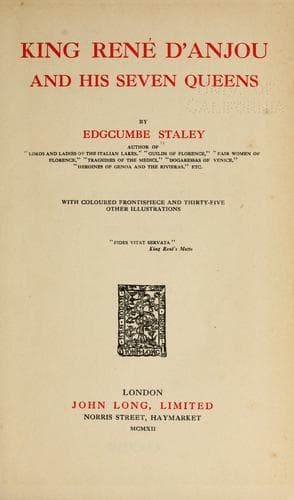
King René d'Anjou and His Seven QueensStaley, Edgcumbe
History
King René d'Anjou and His Seven Queens
Staley, Edgcumbe
France -- Court and courtiers; René I, King of Naples and Jerusalem, 1409-1480
The journey to the south was, as usual, by river barge up the winding
sylvan Loire to Roanne, and thence _à portage_ to Valence, and on by
water past Montelimart, Orange, and Avignon. The King, like other
rulers in France, maintained a fleet of vessels for trade and pleasure
upon the splendid waterways. It was, of course, a royal progress such
as René and his father and brother, and Queen Yolande, his venerated
mother, had often made, and very cordial were the greetings by the
way. At Arles, where the King and Queen were rapturously received,
they found awaiting them deputations from every considerable place in
Provence, each bearing goodly offerings to their liege lord and lady.
Arles presented 400 _écus d’or_ in two enamelled gold flasks, and six
chased cups of silver; Aix, two great bowls of silver embossed and
jewelled, six silver cups, and three goblets of gold; Marseilles, 200
_écus d’or_, to be spent in buying fine wax, at the pleasure of the
Queen,--a treasured possession,--and four silver cups; Avignon, twelve
enamelled silver cups and two gold goblets; Tarascon, a great gold ewer
and six small goblets--and so on. Formalities completed and _Te Deum_
sung, René and Jehanne went off to Aix, there to settle and to arrange
their household affairs. In recognition of this auspicious visit to
Provence, the King created his consort Countess of Les Baux, with
proprietary rights in that ancient stronghold.
The ancient family had become extinct in the comely person of
Countess Alix, a helpless girl placed under the guardianship of her
uncle, Robert de Beaufort, better known as “_Le Fléau de Provence_,”
the leader of a band of ruffians designated “_Les Tards-Venus_.”
Fair Alix died unmarried in 1426, and the county of Les Baux passed
to Louis III. d’Anjou, King René’s brother. For Jehanne de Laval her
loving spouse repaired and decorated the ruinous old castle. The
pleasure-grounds were laid out by René, and the “_Pavillon de la
Royne Jehanne_” erected, a true “_Pavillon d’Amour_,” wherein he and
she could repose and utter sweet nothings to one another, and revive
also some of the fascinating observances of the once famous “Court of
Love” of Les Baux. Spirits of former Countess-Presidents of Chapters
of the Troubadours flitted to and fro the “Chamber of the Rose.” The
beauteous if fateful sisters, Étiennette and Douce, gracious spouses of
two fierce rival Counts, Raymond des Baux and Berenger de Barcelona,
but rivals in the poems and dances of the troubadours, away in the
twelfth century, looked down, perhaps, from the eerie thrones in “_Il
Paradiso_” upon the new Queen of Beauty. The girlish figure, too, of
Cécile des Baux, “_La Passe Rose_,” the fairest beauty of them all,
sought, a century later, the spiritual companionship of Alix, the last
of the châtelaines, with her to observe the graceful figure of Queen
Jehanne. Memories of lovely women and the romances of their lives
Public-domain text, read in full here on John Shaqi.
Reviews
Reviews
No reviews yet
Be the first to share your thoughts on this work.
Elsewhere in the archive
Join the Discussion
Join the discussion
Sign in to leave a comment or review.
Sign InorCreate an account