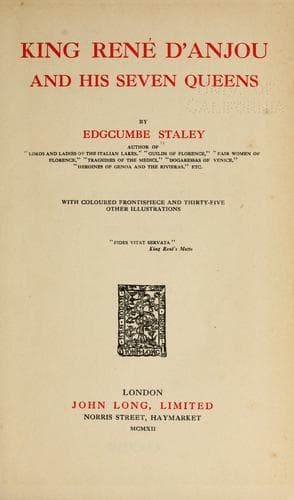
King René d'Anjou and His Seven QueensStaley, Edgcumbe
History
King René d'Anjou and His Seven Queens
Staley, Edgcumbe
France -- Court and courtiers; René I, King of Naples and Jerusalem, 1409-1480
The shy wanderer approaches diffidently, and then the maiden opens her
little luncheon basket, which hangs from her shoulders by blue silken
ribbons, and eats a portion of a roll; to him she offers the remainder.
The fascination of the moment overrides all scruples, and Regnault,
as she has called him, kneels at his enchantress’s feet, strokes her
hands and arms, and protests his love. The damsel is willy-nilly, and
naïvely cries: “All fall in love, and all fall out; and so may you,
fair sir, for aught I know!” Carried away by the vehemence of his
passion, Regnault tries to seize the girl and press his hot lips upon
hers, so coral pink; but she evades him, slips from his grasp, and,
presto! she has vanished. All dazy-wazy Regnault rises, holds out his
hands beseechingly, and then, folding them upon his breast, with bowed
head he seeks once more the mountain shrine, and before our sweet Lady
of Consolation pours out his heart and his soul. Compline still finds
him saying his _Aves_, and Night covers him with her restful shroud;
his last words are addressed to his meadow nymph:
“T’ameray très parfaictment,
Du bon du Cuer si loyaument,
Que ne te fauldray nullement
Jusques à mort.”
“I love thee perfectly,
From bottom of my heart;
I will never fail thee
Till death us two shall part.”
This very beautiful poem the royal lover entitled “_Regnault et
Jehanneton_,” or “_Les Amours du Bergier et de la Bergeronne_,”--a
play, of course, upon his own name and Queen Jehanne’s. At the end of
the manuscript René drew a very pretty design--side by side two shields
of arms, his and Jehanne’s, united by a royal crown; his supporter,
on the left, _une souche_,--the stump of a forest tree,--with one
flourishing foliaged branch bearing a censer of burning incense; her
supporter, on the right, a chestnut-tree in full flower, and on a
branch two royal paroquets--lovebirds!
In 1457 the poet-King put forth an allegory of chivalry which he called
“_La Conqueste de Doulce Mercy par le Cuer d’Amour espris_.” The
conceit of the story is just a simple knight,--youthful, vigorous, and
a true lover of women,--setting forth for the devotion he holds for his
mistress to endure perilous adventures. René himself is, of course, the
hero of the poem, the intrepid soldier of Naples, the heroic prisoner
of Bulgneville.
The opening of the poem reveals “_le Bon Roy_” one night wakeful, and
suffering heartache--“_Mortie dormant en resverie_.” It appeared to
him that his heart left his breast, and that “_Vif Désire_” whispered
gently:
“Si, Doulce Mercy,
Desires de povoir avoir,
Il fault que tu faces devoir
Par la force d’armes l’acquerir.”
“If, True Chivalry,
Thou wouldst have power,
Then thy metal try
And by arms acquire.”
Public-domain text, read in full here on John Shaqi.
Reviews
Reviews
No reviews yet
Be the first to share your thoughts on this work.
Elsewhere in the archive
Join the Discussion
Join the discussion
Sign in to leave a comment or review.
Sign InorCreate an account