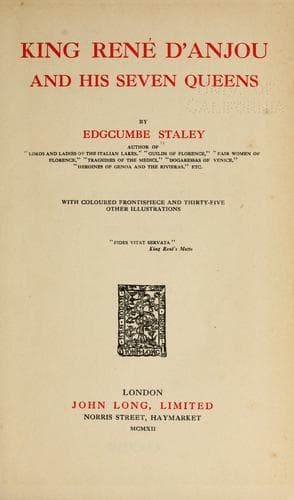
King René d'Anjou and His Seven QueensStaley, Edgcumbe
History
King René d'Anjou and His Seven Queens
Staley, Edgcumbe
France -- Court and courtiers; René I, King of Naples and Jerusalem, 1409-1480
The Castle of Beaufort was built upon a lofty rock rising above
the Loire, overlooking the whole of that fertile and lovely valley;
from its battlements both Angers and Saumur were visible. King René
purchased it and its estate in 1469 for 30,000 gold crowns, and
assigned it as part of Queen Jehanne’s fortune. After the King’s death
and burial, and when she had taken a sad and affectionate farewell of
her devoted people in Provence, the royal widow settled down in this
attractive residence, and there spent the residue of her life. The
_Comptes_ contain many items for building materials, decoration, and
furniture, showing King René’s anxiety to make his dear wife’s bijou
residence a very real pleasaunce for her.
René indeed was a master-builder, not merely in the way of a hobby,
but practically and in many places. He studied the works of Leon
Battista Alberti and other famous architects, and entertained and
employed numbers of Italian sculptors. Pietro da Milano was one of
these; he was engaged principally in Barrois, and there added the
duties of director of revels to his other artistic occupations. Marble
busts of René and Jehanne, of Queen Margaret of England and her unhappy
son Edward, Prince of Wales, of Ferri de Vaudémont and Yolande, with
their young son René, and many others, found expression under Pietro’s
skilful chisel. In the “_Farce des Pastoureaux_,” acted at the Palace
of Bar-le-Duc in August, 1463, King René provided costly dresses for
his clever little namesake grandson, then twelve years old, and for
the rest of the juvenile cast; these were made by Noel Bontault,
after Pietro da Milano’s designs. The King and his Court were then in
residence at the Castle of Louppy, which he had repaired along with
the castles of Clermont en Argonne, de Koeurs, and Bonconville, and
where he received and comforted his miserable daughter, the heroic
consort of Henry VI. Queen Jehanne’s ministrations to the forlorn
Queen were tenderly rendered and gratefully received. She is credited
with the characteristically graceful acts of reclothing the fugitive,
and according to Queen Margaret precedence and homage. King René’s
handiwork in all these enterprises was varied and extensive. He painted
the windows, he carved the escutcheons of arms, and he fashioned the
hinges and locks of the doors. The _Comptes_ prove by very many entries
his royal excellence as a craftsman as well as an artist. Scarcely a
church in Barrois, Lorraine, Anjou, and Provence, but bore evidence of
the kingly artistry. Perhaps his two specialities were glass working
and decorating, and wool and silk weaving and embroidery.
Public-domain text, read in full here on John Shaqi.
Reviews
Reviews
No reviews yet
Be the first to share your thoughts on this work.
Elsewhere in the archive
Join the Discussion
Join the discussion
Sign in to leave a comment or review.
Sign InorCreate an account