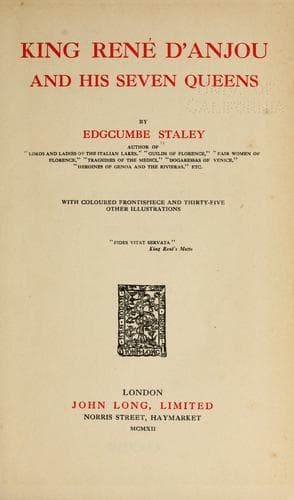
King René d'Anjou and His Seven QueensStaley, Edgcumbe
History
King René d'Anjou and His Seven Queens
Staley, Edgcumbe
France -- Court and courtiers; René I, King of Naples and Jerusalem, 1409-1480
Every door and window was set wide ajar that, night or day, all might
see and pray and bless. Dusk fell on that long, long day, but the crowd
of loving servants and subjects still surged along reverently to pay
their last respects; and so night fell and passed, not in the peaceful
hush of slumber, but with smothered tread of painful feet and the
smothered sob of woe.
All Aix was hung in black, and on July 14 the streets were lined by
weeping citizens as the funeral cortège of “_le bon Roy_” passed to
the Cathedral of St. Sauveur. The burial casket, after the requiem and
Court ceremonies, was placed, not in a tomb direct, but in a _chapelle
ardente_, and watches of religious mounted guard and prayed. Soon the
wish of their venerated Sovereign was made public property, and then,
amid fresh lamentations lest Aix should lose his remains, appeals were
made to Queen Jehanne. She was deeply affected, but remained quiet and
resigned. She could not reverse her husband’s will, but she could allow
his body to remain awhile where it was. With this the authorities had
to be content, and forthwith, to strengthen their hold upon that sacred
casket, steps were taken to erect a splendid monument and tomb. An
embassy was sent off at once to Rome to ask for a “Bull” whereby the
late Sovereign’s directions as to the place of sepulture might be laid
aside. Aix was not so much jealous of Angers as she was devoted to her
King.
In accordance with the marital customs of the time, King René had
a mistress--perhaps more than one, but one at least whose name has
been preserved by chroniclers, Marie de la Chapelle, a respectable
middle-class woman of Provence. Whether “de la Chapelle” was a
sobriquet or not is not clear; probably it was so, and given her later
on in life after the artist King had painted her wearing a _chapelle_,
or black velvet hood, in a diptych, wherein he faces her, which he kept
secretly in his own studio. It is said that she did not really love
René, but liked to rule him and to direct the royal household. She was
exigeant, too, for the legitimatizing of the three children she bore
the King, whom René had always duly acknowledged as his. These were
Jean, “_le Bâtard d’Angers_,” created, after the premature death of
Prince Louis, Marquis de Pont-à-Mousson and Seigneur of St. Cannot;
Blanche; and Madeleine. Jean married Isabelle, daughter of Raymond de
Glandevez, Ambassador to the Pope, pro-Governor of Genoa, and Grand
Master of France. Blanche d’Anjou married Bertrand de Beauvau, Seigneur
de Precigny, Master of the Court of Angers and Seneschal of Anjou. He
was in 1462 appointed President of Provence. His father was Seigneur
de Rochette. René gave his daughter the estate of Mirabeau in Poitou,
which he purchased in 1488. In the _Comptes du Roy René_ is the record
of a gift to Blanche of a gold mirror worth 20 _écus d’or_, under
date January 12, 1488, and the same year, on March 18, she received a
Public-domain text, read in full here on John Shaqi.
Reviews
Reviews
No reviews yet
Be the first to share your thoughts on this work.
Elsewhere in the archive
Join the Discussion
Join the discussion
Sign in to leave a comment or review.
Sign InorCreate an account