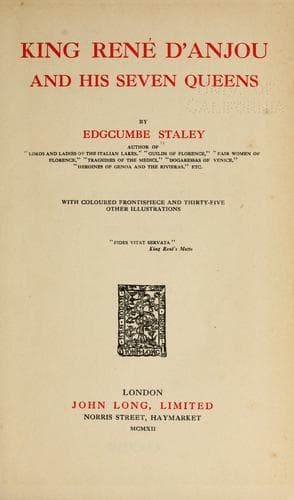
King René d'Anjou and His Seven QueensStaley, Edgcumbe
History
King René d'Anjou and His Seven Queens
Staley, Edgcumbe
France -- Court and courtiers; René I, King of Naples and Jerusalem, 1409-1480
It came certainly as a grievous shock to all that enthusiastic
expedition to find the King,--“poor as a church mouse and defenceless
as a rabbit,”--engaged in frivolities and excesses. The Court at
Chinon was the maddest and the merriest in France. Duke René, true to
his promise, at once sought out the King, and arranged an interview
with the Maid of Domremy, although His Majesty at first refused “to
be troubled with a country wench.” The meeting was held in the Grand
Logis of the enceinte of the Château du Milieu. Chinon, indeed, had
three castles connected with one another: The Château de St. Georges
was a sort of advanced fortress, built by Henri Plantagenet (Henry
II. of England) in the twelfth century, but greatly dilapidated 300
years later; the Château du Milieu, the most important part of Chinon,
contained the royal apartments; and the Château de Couldray, the most
ancient, dating from the time of the heroic Thibaut le Tricheur, early
in the tenth century. Henry II. died in the Grand Logis, where King
Charles VII. had his temporary residence. In the Salle du Trône, with
its vast chimney-piece of sculptured stone and its famous painted
windows, the King summoned his courtiers, and, disguised as an ordinary
noble of the Court, he mingled with them, giving out as his reason that
he should “test the wench’s power of divination. If she picks me out
at once, then I will hear what she has to say; if not, I won’t have
anything to do with her.”
Jeanne was brought into the splendid apartment, filled with the
pageantry of France, and dazzling enough to have disturbed any
ordinary girl’s equanimity. She made, taught by René, an obeisance to
the empty throne, and then he told her she must find the King among
the company. Without a moment’s hesitation she went straight up to
the Sovereign incognito, bowed low, and said softly: “Sire, you are
Charles the Dauphin.” Very much astonished by Jeanne’s appearance and
demeanour, and still more by her certainty as to his identity, Charles
acknowledged himself, and, leading the unabashed damsel with René aside
into the embrasure of a window, he asked her to give him her message.
This Jeanne did with candour and emphasis, and furthermore astounded
“the Dauphin,” as she persisted in calling him,--he had not been
crowned King, of course,--by “revealing,” as he told René afterwards,
“certain secrets known only to myself and God.” What these “secrets”
were has puzzled curious inquirers. Probably they concerned happenings
during the King’s youth, and affected the question of his legitimacy.
He, too, was at one time proposed as the husband of the “Pride of
Lorraine,” the heiress Isabelle. Anyhow, as known to Jeanne d’Arc,
they were the usual exaggerations of Court and country gossip. Kings,
knights, and ladies, and their doings, ever cause peasants topics for
discussion.
Public-domain text, read in full here on John Shaqi.
Reviews
Reviews
No reviews yet
Be the first to share your thoughts on this work.
Elsewhere in the archive
Join the Discussion
Join the discussion
Sign in to leave a comment or review.
Sign InorCreate an account