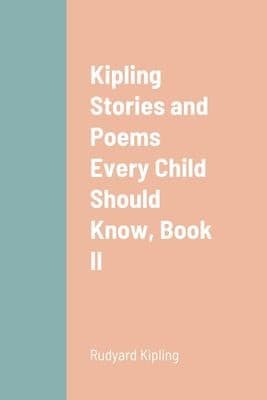
Kipling Stories and Poems Every Child Should Know, Book IIKipling, Rudyard
General
Kipling Stories and Poems Every Child Should Know, Book II
Kipling, Rudyard
Poetry; Short stories
"Surely we are Gods still," said the Girl. "Do you not remember when
you and I went to the House of the Crab and--were not very much
afraid? And since then ... we have forgotten what we were singing
for--we sang for the pence, and, oh, we fought for them!--We, who are
the Children of the Zodiac!"
"It was my fault," said Leo.
"How can there be any fault of yours that is not mine too?" said the
Girl. "My time has come, but you will live longer, and...." The look
in her eyes said all she could not say.
"Yes, I will remember that we are Gods," said Leo.
It is very hard, even for a child of the Zodiac who has forgotten his
Godhead, to see his wife dying slowly, and to know that he cannot help
her. The Girl told Leo in those last months of all that she had said
and done among the wives and the babies at the back of the roadside
performances, and Leo was astonished that he knew so little of her who
had been so much to him. When she was dying she told him never to
fight for pence or quarrel with the other singers; and, above all, to
go on with his singing immediately after she was dead.
Then she died, and after he had buried her he went down the road to a
village that he knew, and the people hoped that he would begin
quarrelling with a new singer that had sprung up while he had been
away. But Leo called him "my brother." The new singer was newly
married--and Leo knew it--and when he had finished singing Leo
straightened himself, and sang the "Song of the Girl," which he had
made coming down the road. Every man who was married, or hoped to be
married, whatever his rank or colour, understood that song--even the
bride leaning on the new husband's arm understood it too--and
presently when the song ended, and Leo's heart was bursting in him,
the men sobbed. "That was a sad tale," they said at last, "now make us
laugh." Because Leo had known all the sorrow that a man could know,
including the full knowledge of his own fall who had once been a
God--he, changing his song quickly, made the people laugh till they
could laugh no more. They went away feeling ready for any trouble in
reason, and they gave Leo more peacock feathers and pence than he
could count. Knowing that pence led to quarrels and that peacock
feathers were hateful to the Girl, he put them aside and went away to
look for his brothers, to remind them that they too were Gods.
He found the Bull goring the undergrowth in a ditch, for the Scorpion
had stung him, and he was dying, not slowly, as the Girl had died, but
quickly.
"I know all," the Bull groaned, as Leo came up. "I had forgotten, too,
but I remember now. Go and look at the fields I ploughed. The furrows
are straight. I forgot that I was a God, but I drew the plough
perfectly straight, for all that. And you, brother?"
"I am not at the end of the ploughing," said Leo. "Does Death hurt?"
"No; but dying does," said the Bull, and he died. The cultivator who
then owned him was much annoyed, for there was a field still
unploughed.
Public-domain text, read in full here on John Shaqi.
Reviews
Reviews
No reviews yet
Be the first to share your thoughts on this work.
Elsewhere in the archive
Join the Discussion
Join the discussion
Sign in to leave a comment or review.
Sign InorCreate an account