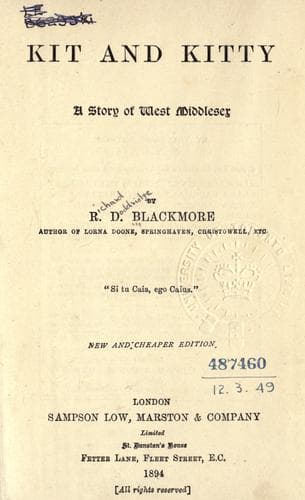
Kit and Kitty: A Story of West MiddlesexBlackmore, R. D. (Richard Doddridge)
General
Kit and Kitty: A Story of West Middlesex
Blackmore, R. D. (Richard Doddridge)
Middlesex (England) -- Fiction
When I had been gone, at least a fortnight, I should say—though I
could not be certain about dates just then—to my Aunt Parslow’s at
Leatherhead, my uncle having done all his grafting by himself, for
there always was some to do every year, took a general look at his
trees, and found that the buds looked as promising as ever he had seen
them. He was rather surprised at this, not at all on account of the
long hard winter, but because of the very cold wet summer and autumn
which had preceded it. The trees would be full of unripe wood, and
sappy shoots shrivelled by the frost, and scurfy bark, and perished
boughs, and general discomfort, and sulkiness. At least everybody said
that was how they ought to be, and my uncle had never contradicted
them, preferring a little pessimism, because it is always the safer
side. And probably upon cold, wet soils, all the evils predicted had
succeeded, which would make it all the better for the places where
they failed. So that my uncle, while sympathizing warmly with all his
brother growers in their bad look-out, shook his head about his own,
and smoked his pipe, and would not speak of his chickens, much less
count them.
But, when the sun began to get the upper hand of the days again, and
the spring was looking through the hedge and into the hearts of the
trees almost, and the earth seemed ready to lift its breast, as a
maiden does for her flowers to be fixed, and every shrub that showed
a leaf had got a bird to sing to it—for a time, the best man found
it hard to make the worst of everything; and even the often frozen
grower hoped not to be frozen again this year. For the later an English
fruit-tree is in showing its white or pink challenge to the sky, the
less is the chance of unheavenly heaven descending with a white blow,
and smiting all to utter blackness. The ground had been frozen to a
depth of twenty inches by the rigour of enduring frost; and after that
the push of spring takes a long time to get down the line.
“Tompkins,” said my uncle, who was poking about with a spade, to
kill snails in some Iris roots, for no sort of winter makes much
difference to a snail; drought in their breeding-time is all they care
for much—“Tompkins, it is high time to be looking up our baskets. In
another month, those fellows will be sticking it on again.”
“That ’em will,” the long man replied. He was short of tongue, as a
very tall man, by some ordinance of Nature, almost always is—perhaps
because his fellow-creatures’ hats have endangered it while it was
tender.
Public-domain text, read in full here on John Shaqi.
Reviews
Reviews
No reviews yet
Be the first to share your thoughts on this work.
Elsewhere in the archive
Join the Discussion
Join the discussion
Sign in to leave a comment or review.
Sign InorCreate an account