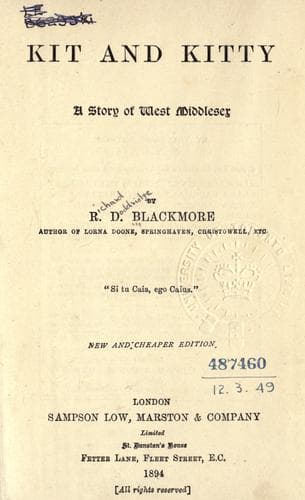
Kit and Kitty: A Story of West MiddlesexBlackmore, R. D. (Richard Doddridge)
General
Kit and Kitty: A Story of West Middlesex
Blackmore, R. D. (Richard Doddridge)
Middlesex (England) -- Fiction
However, I made the best of my uncle’s conduct at our cottage; for it
was not only my duty, but my important interest to do so. What was to
become of us if Uncle Corny (who might be called a huffy man, and
stuck to a huff, whenever he contracted it) should take it into his
head that I was not what he used to take me for? I know that he was
full of truth and justice, according to his own view of them; but if
anything went against his liking, so did truth and justice. So I had to
sink my opinions often, even when they agreed with his, for he never
liked to have them put into any other language than his own. Kitty was
clever enough to see this, and she always praised me afterwards; but
it went against one’s sense of right, that she might say exactly what
I had said, and from her lips it became true wisdom, when it had been
simple silliness from mine. But Kitty smiled at him, and laughed at me,
and went into his heart more deeply every time she filled his pipe.
Then a new anxiety arose, and Uncle Corny had more than he could do to
lay down the law for his own affairs. The wind went into the east, with
a hard blue sky, and not a cloud in it. We had passed the date of the
“icy Saints,” as they are called in Germany, when a cold wave of air
is said to flow over hundreds of leagues of smiling land, and smite it
all into one dark frown. If I can remember, without an almanac, that
date is about the seventh of May; but I have never found it quite so
punctual here; and according to my observation, the bloom of England
hovers in nightly peril, from the middle of April to the very end of
May. It is one of the many sad things we meet, but can only fold our
hands and watch, that for nearly six weeks of the year, and in early
seasons even more, through all our level southern lands, the fruit-crop
trembles on the hazard of a single night’s caprice. The bright sun
and the lovely day delude the folk who know no better; these are the
very things that lead to the starry night, and the quiet cold, and the
white sheet over the grass at five a.m., and the black death following.
The barren grower walks between his rows of wounded blossom; there is
little harm to be seen at first, some of the petals are as fair as
ever, others are just tipped with brown; and perhaps his wife runs up
and says—“Oh, you need not be in a fright, my dear; why, they all look
as well as ever.”
But he, with deeper wisdom, and the smile of prophetic silence, pulls
out his budding-knife, and nips the fairest truss he can find of bloom.
Then he lays it in his palm, and haply with keen edge bisects the pips.
A keener edge has been there before him; a little black line passes up
from the baby stalk to the pistil. The ovary is dead and shrunken,
though the anthers still may be tipped with pink. Never shall a fruit
grow there, to swell and stripe itself with sun, to flood a plate with
sprightly juice, and in its dissolution hear some sweet voice say—“Oh,
I never did taste such a lovely pear!”
Public-domain text, read in full here on John Shaqi.
Reviews
Reviews
No reviews yet
Be the first to share your thoughts on this work.
Elsewhere in the archive
Join the Discussion
Join the discussion
Sign in to leave a comment or review.
Sign InorCreate an account