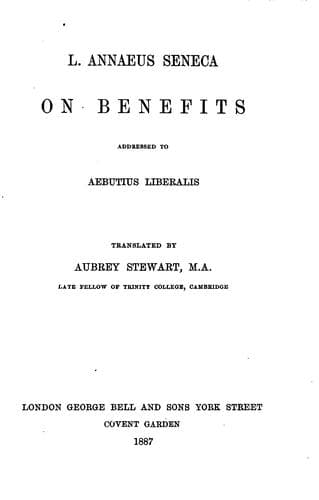
L. Annaeus Seneca on BenefitsSeneca, Lucius Annaeus
Philosophy
L. Annaeus Seneca on Benefits
Seneca, Lucius Annaeus
Benevolence; Classical literature; Conduct of life; Essays
XXIV. One of Julius Caesar's veterans was once pleading before him
against his neighbours, and the cause was going against him. "Do you
remember, general," said he, "that in Spain you dislocated your ankle
near the river Sucro [Footnote: Xucar]?" When Caesar said that he
remembered it, he continued, "Do you remember that when, during the
excessive heat, you wished to rest under a tree which afforded very
little shade, as the ground in which that solitary tree grew was rough
and rocky, one of your comrades spread his cloak under you?" Caesar
answered, "Of course, I remember; indeed, I was perishing with thirst;
and since was unable to walk to the nearest spring, I would have crawled
thither on my hands and knees, had not my comrade, a brave and active
man, brought me water in his helmet." "Could you, then, my general,
recognize that man or that helmet?" Caesar replied that he could not
remember the helmet, but that he could remember the man well; and he
added, I fancy in anger at being led away to this old story in the midst
of a judicial enquiry, "At any rate, you are not he." "I do not blame
you, Caesar," answered the man, "for not recognizing me; for when this
took place, I was unwounded; but afterwards, at the battle of Munda,
my eye was struck out, and the bones of my skull crushed. Nor would
you recognize that helmet if you saw it, for it was split by a Spanish
sword." Caesar would not permit this man to be troubled with lawsuits,
and presented his old soldier with the fields through which a village
right of way had given rise to the dispute.
XXV. In this case, what ought he to have done? Because his commander's
memory was confused by a multitude of incidents, and because his
position as the leader of vast armies did not permit him to notice
individual soldiers, ought the man not to have asked for a return for
the benefit which he had conferred? To act as he did is not so much to
ask for a return as to take it when it lies in a convenient position
ready for us, although we have to stretch out our hands in order to
receive it. I shall therefore ask for the return of a benefit, whenever
I am either reduced to great straits, or where by doing so I shall act
to the advantage of him from whom I ask it. Tiberius Caesar, when some
one addressed him with the words, "Do you remember....?" answered,
before the man could mention any further proofs of former acquaintance,
"I do not remember what I was." Why should it not be forbidden to demand
of this man repayment of former favours? He had a motive for forgetting
them: he denied all knowledge of his friends and comrades, and wished
men only to see, to think, and to speak of him as emperor. He regarded
his old friend as an impertinent meddler.
Public-domain text, read in full here on John Shaqi.
Reviews
Reviews
No reviews yet
Be the first to share your thoughts on this work.
Elsewhere in the archive
Join the Discussion
Join the discussion
Sign in to leave a comment or review.
Sign InorCreate an account