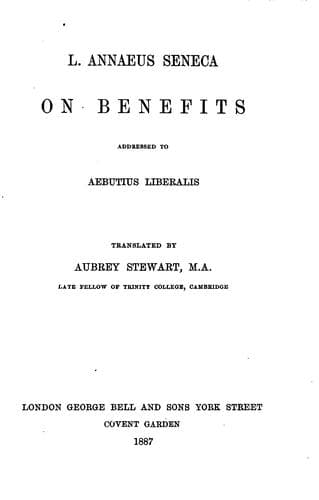
L. Annaeus Seneca on BenefitsSeneca, Lucius Annaeus
Philosophy
L. Annaeus Seneca on Benefits
Seneca, Lucius Annaeus
Benevolence; Classical literature; Conduct of life; Essays
that he taught me something more than is taught by all masters alike;
that he roused my better feelings by his encouragement, and that at
one time he would raise my spirits by praise, and at another warn me
to shake off slothfulness: that he laid his hand, as it were, upon my
latent and torpid powers of intellect and drew them out into the light
of day; that he did not stingily dole out to me what he knew, in order
that he might be wanted for a longer time, but was eager, if possible,
to pour all his learning into me; then I am ungrateful, if I do not love
him as much as I love my nearest relatives and my dearest friends.
XVII. We give something additional even to those who teach the meanest
trades, if their efforts appear to be extraordinary; we bestow a
gratuity upon pilots, upon workmen who deal with the commonest materials
and hire themselves out by the day. In the noblest arts, however, those
which either preserve or beautify our lives, a man would be ungrateful
who thinks he owes the artist no more than he bargained for. Besides
this, the teaching of such learning as we have spoken of blends mind
with mind; now when this takes place, both in the case of the physician
and of the teacher the price of his work is paid, but that of his mind
remains owing.
XVIII. Plato once crossed a river, and as the ferryman did not ask him
for anything, he supposed that he had let him pass free out of respect,
and said that the ferryman had laid Plato under an obligation. Shortly
afterwards, seeing the ferryman take one person after another across the
river with the same pains, and without charging anything, Plato declared
that the ferryman had not laid him under an obligation. If you wish me
to be grateful for what you give, you must not merely give it to me, but
show that you mean it specially for me; you cannot make any claim upon
one for having given him what you fling away broad-cast among the crowd.
What then? shall I owe you nothing for it? Nothing, as an individual; I
will pay, when the rest of mankind do, what I owe no more than they.
Public-domain text, read in full here on John Shaqi.
Reviews
Reviews
No reviews yet
Be the first to share your thoughts on this work.
Elsewhere in the archive
Join the Discussion
Join the discussion
Sign in to leave a comment or review.
Sign InorCreate an account