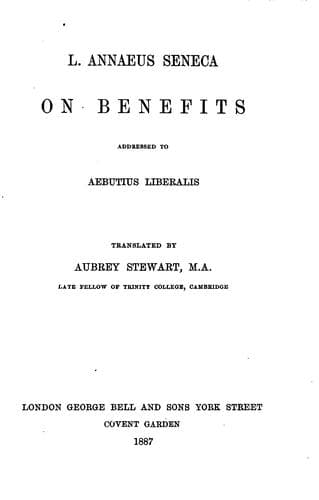
L. Annaeus Seneca on BenefitsSeneca, Lucius Annaeus
Philosophy
L. Annaeus Seneca on Benefits
Seneca, Lucius Annaeus
Benevolence; Classical literature; Conduct of life; Essays
XXXVI. Who would call Aeneas pious, if he wished that his native
city might be captured, in order that he might save his father from
captivity? Who would point to the Sicilian youths as good examples for
his children, if they had prayed that Aetna might flame with unusual
heat and pour forth a vast mass of fire in order to afford them an
opportunity of displaying their filial affection by rescuing their
parents from the midst of the conflagration? Rome owes Scipio nothing
if he kept the Punic War alive in order that he might have the glory of
finishing it; she owes nothing to the Decii if they prayed for public
disasters, to give themselves an opportunity of displaying their brave
self-devotion. It is the greatest scandal for a physician to make work
for himself; and many who have aggravated the diseases of their patients
that they may have the greater credit for curing them, have either
failed to cure them, at all or have done so at the cost of the most
terrible suffering to their victims.
XXXVII. It is said (at any rate Hecaton tells us) that when Callistratus
with many others was driven into exile by his factious and licentiously
free country, some one prayed that such trouble might befall the
Athenians that they would be forced to recall the exiles, on hearing
which, he prayed that God might forbid his return upon such terms. When
some one tried to console our own countryman, Rutilius, for his exile,
pointing out that civil war was at hand, and that all exiles would soon
be restored to Rome, he answered with even greater spirit, "What harm
have I done you, that you should wish that I may return to my country
more unhappily than I quit it? My wish is, that my country should blush
at my being banished, rather than that she should mourn at my having
returned." An exile, of which every one is more ashamed than the
sufferer, is not exile at all. These two persons, who did not wish to be
restored to their homes at the cost of a public disaster, but preferred
that two should suffer unjustly than that all should suffer alike, are
thought to have acted like good citizens; and in like manner it does not
accord with the character of a grateful man, to wish that his benefactor
may fall into troubles which he may dispel; because, even though he may
mean well to him, yet he wishes him evil. To put out a fire which you
yourself have lighted, will not even gain acquittal for you, let alone
credit.
Public-domain text, read in full here on John Shaqi.
Reviews
Reviews
No reviews yet
Be the first to share your thoughts on this work.
Elsewhere in the archive
Join the Discussion
Join the discussion
Sign in to leave a comment or review.
Sign InorCreate an account