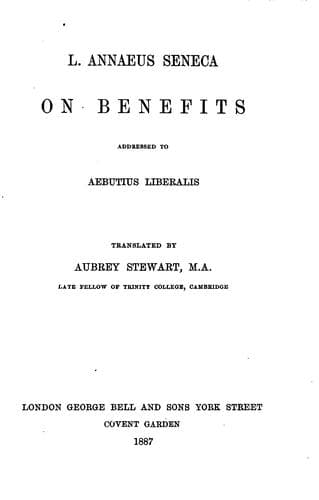
L. Annaeus Seneca on BenefitsSeneca, Lucius Annaeus
Philosophy
L. Annaeus Seneca on Benefits
Seneca, Lucius Annaeus
Benevolence; Classical literature; Conduct of life; Essays
IV. "This," say you, "is the very thing that I wanted! I have caught
you! I shall be glad to see how you will extricate yourself from the
toils into which you have fallen of your own accord. Tell me, if the
wise man possesses everything, how can one give anything to a wise man?
for even what you give him is his already. It is impossible, therefore,
to bestow a benefit upon a wise man, if whatever is given him comes from
his own store; yet you Stoics declare that it is possible to give to
a wise man. I make the same inquiry about friends as well: for you
say that friends own everything in common, and if so, no one can give
anything to his friend, for he gives what his friend owned already in
common with himself."
There is nothing to prevent a thing belonging to a wise man, and yet
being the property of its legal owner. According to law everything in a
state belongs to the king, yet all that property over which the king has
rights of possession is parcelled out among individual owners, and
each separate thing belongs to somebody: and so one can give the king
a house, a slave, or a sum of money without being said to give him what
was his already; for the king has rights over all these things, while
each citizen has the ownership of them. We speak of the country of the
Athenians, or of the Campanians, though the inhabitants divide them
amongst themselves into separate estates; the whole region belongs to
one state or another, but each part of it belongs to its own individual
proprietor; so that we are able to give our lands to the state, although
they are reckoned as belonging to the state, because we and the state
own them in different ways. Can there be any doubt that all the private
savings of a slave belong to his master as well as he himself? yet he
makes his master presents. The slave does not therefore possess nothing,
because if his master chose he might possess nothing; nor does what he
gives of his own free will cease to be a present, because it might have
been wrung from him against his will. As for how we are to prove that
the wise man possesses all things, we shall see afterwards; for the
present we are both agreed to regard this as true; we must gather
together something to answer the question before us, which is, how any
means remain of acting generously towards one who already possesses all
things? All things that a son has belong to his father, yet who does not
know that in spite of this a son can make presents to his father? All
things belong to the gods; yet we make presents and bestow alms even
upon the gods. What I have is not necessarily not mine because it
belongs to you; for the same thing may belong both to me and to you.
Public-domain text, read in full here on John Shaqi.
Reviews
Reviews
No reviews yet
Be the first to share your thoughts on this work.
Elsewhere in the archive
Join the Discussion
Join the discussion
Sign in to leave a comment or review.
Sign InorCreate an account