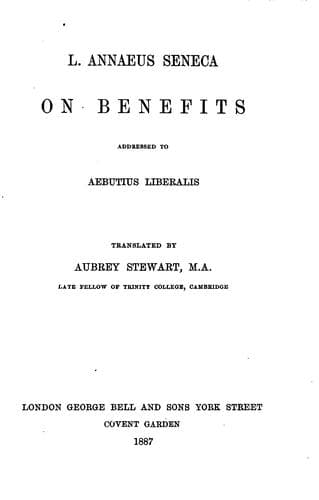
L. Annaeus Seneca on BenefitsSeneca, Lucius Annaeus
Philosophy
L. Annaeus Seneca on Benefits
Seneca, Lucius Annaeus
Benevolence; Classical literature; Conduct of life; Essays
VI. In all the cases which I have mentioned, each party is the owner of
the same thing. How is this? It is because the one owns the thing, the
other owns the use of the thing. We speak of the books of Cicero. Dorus,
the bookseller, calls these same books his own; the one claims them
because he wrote them, the other because he bought them; so that they
may quite correctly be spoken of as belonging to either of the two, for
they do belong to each, though in a different manner. Thus Titus Livius
may receive as a present, or may buy his own books from Dorus.
Although the wise man possesses everything, yet I can give him what I
individually possess; for though, king-like, he in his mind possesses
everything, yet the ownership of all things is divided among various
individuals, so that he can both receive a present and owe one; can
buy, or hire things. Everything belongs to Caesar; yet he has no private
property beyond his own privy purse; as Emperor all things are his,
but nothing is his own except what he inherits. It is possible, without
treason, to discuss what is and what is not his; for even what the court
may decide not to be his, from another point of view is his. In the same
way the wise man in his mind possesses everything, in actual right and
ownership he possesses only his own property.
VII. Bion is able to prove by argument at one time that everyone is
sacrilegious, at another that no one is. When he is in a mood for
casting all men down the Tarpeian rock, he says, "Whosoever touches that
which belongs to the gods, and consumes it or converts it to his own
uses, is sacrilegious; but all things belong to the gods, so that
whatever thing any one touches belongs to them to whom all belongs;
whoever, therefore, touches anything is sacrilegious." Again, when he
bids men break open temples and pillage the Capitol without fear of the
wrath of heaven, he declares that no one can be sacrilegious; because,
whatever a man takes away, he takes from one place which belongs to the
gods into another place which belongs to the gods. The answer to this
is that all places do indeed belong to the gods, but all are not
consecrated to them, and that sacrilege can only be done in places
solemnly dedicated to heaven. Thus, also, the whole world is a temple of
the immortal gods, and, indeed, the only one worthy of their greatness
and splendour, and yet there is a distinction between things sacred and
profane; all things which it is lawful to do under the sky and the stars
are not lawful to do within consecrated walls. The sacrilegious man
cannot do God any harm, for He is placed beyond his reach by His divine
nature; yet he is punished because he seems to have done Him harm: his
punishment is demanded by our feeling on the matter, and even by his
own. In the same way, therefore, as he who carries off any sacred
things is regarded as sacrilegious, although that which he stole is
nevertheless within the limits of the world, so it is possible to steal
Public-domain text, read in full here on John Shaqi.
Reviews
Reviews
No reviews yet
Be the first to share your thoughts on this work.
Elsewhere in the archive
Join the Discussion
Join the discussion
Sign in to leave a comment or review.
Sign InorCreate an account