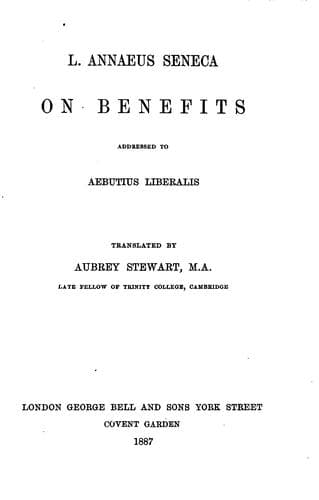
L. Annaeus Seneca on BenefitsSeneca, Lucius Annaeus
Philosophy
L. Annaeus Seneca on Benefits
Seneca, Lucius Annaeus
Benevolence; Classical literature; Conduct of life; Essays
XIX. There is no doubt that a slave can bestow a benefit upon anyone;
why, then, not upon his master? "Because," it is argued, "he cannot
become his master's creditor if he gives him money. If this be not so,
he daily lays his master under an obligation to him; he attends him when
on a journey, he nurses him when sick, he works most laboriously at the
cultivation of his estate; yet all these, which would be called benefits
if done for us by anyone else, are merely called service when done by
a slave. A benefit is that which some one bestows who has the option of
withholding it:--now a slave has no power to refuse, so that he does
not afford us his help, but obeys our orders, and cannot boast of having
done what he could not leave undone." Even under these conditions I
shall win the day, and will place a slave in such positions, that for
many purposes he will be free; in the meanwhile, tell me, if I give you
an instance of a slave fighting for his master's safety without regard
to himself, pierced through with wounds, yet spending the last drops of
his blood, and gaining time for his master to escape by the sacrifice of
his life, will you say that this man did not bestow a benefit upon his
master because he was a slave? If I give an instance of one who could
not be bribed to betray his master's secrets by any of the offers of
a tyrant, who was not terrified by any threats, nor overpowered by any
tortures, but who, as far as he was able, placed his questioners upon a
wrong scent, and, paid for his loyalty with his life; will you say
that this man did not confer a benefit upon his master because he was a
slave? Consider, rather, whether an example of virtue in a slave be not
all the greater because it is rarer than in free men, and whether it be
not all the more gratifying that, although to be commanded is odious,
and all submission to authority is irksome, yet in some particular cases
love for a master has been more powerful than men's general dislike to
servitude. A benefit does not, therefore, cease to be a benefit because
it is bestowed by a slave, but is all the greater on that account,
because not even slavery could restrain him from bestowing it.
Public-domain text, read in full here on John Shaqi.
Reviews
Reviews
No reviews yet
Be the first to share your thoughts on this work.
Join the Discussion
Join the discussion
Sign in to leave a comment or review.
Sign InorCreate an account