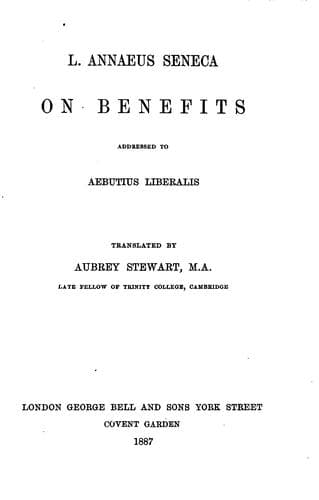
L. Annaeus Seneca on BenefitsSeneca, Lucius Annaeus
Philosophy
L. Annaeus Seneca on Benefits
Seneca, Lucius Annaeus
Benevolence; Classical literature; Conduct of life; Essays
XXII. It has pleased Chrysippus to define a slave as "a hireling for
life." Just as a hireling bestows a benefit when he does more than he
engaged himself to do, so when a slave's love for his master raises him
above his condition and urges him to do something noble--something which
would be a credit even to men more fortunate by birth--he surpasses the
hopes of his master, and is a benefit found in the house. Do you think
it is just that we should be angry with our slaves when they do less
than their duty, and that we should not be grateful to them when they do
more? Do you wish to know when their service is not a benefit? When the
question can be asked, "What if he had refused to do it?" When he does
that which he might have refused to do, we must praise his good will.
Benefits and wrongs are opposites; a slave can bestow a benefit upon his
master, if he can receive a wrong from his master. Now an official has
been appointed to hear complaints of the wrongs done by masters to their
slaves, whose duty it is to restrain cruelty and lust, or avarice in
providing them with the necessaries of life. What follows, then? Is it
the master who receives a benefit from his slave? nay, rather, it is
one man who receives it from another. Lastly, he did all that lay in his
power; he bestowed a benefit upon his master; it lies in your power to
receive or not to receive it from a slave. Yet who is so exalted, that
fortune may not make him need the aid even of the lowliest?
XXIII. I shall now quote a number of instances of benefits, not all
alike, some even contradictory. Some slaves have given their master
life, some death; have saved him when perishing, or, as if that were
not enough, have saved him by their own death; others have helped
their master to die, some have saved his life by stratagem. Claudius
Quadrigarius tells us in the eighteenth book of his "Annals," that
when Grumentum was being besieged, and had been reduced to the greatest
straits, two slaves deserted to the enemy, and did valuable service.
Afterwards, when the city was taken, and the victors were rushing wildly
in every direction, they ran before every one else along the streets,
which they well knew, to the house in which they had been slaves, and
drove their mistress before them; when they were asked who she might
be, they answered that she was their mistress, and a most cruel one, and
that they were leading her away for punishment. They led her outside the
walls, and concealed her with the greatest care until the fighting
was over; then, as the soldiery, satisfied with the sack of the city,
quickly resumed the manners of Romans, they also returned to their
own countrymen, and themselves restored their mistress to them. She
manumitted each of them on the spot, and was not ashamed to receive her
life from men over whom she had held the power of life and death. She
might, indeed, especially congratulate herself upon this; for had
Public-domain text, read in full here on John Shaqi.
Reviews
Reviews
No reviews yet
Be the first to share your thoughts on this work.
Join the Discussion
Join the discussion
Sign in to leave a comment or review.
Sign InorCreate an account