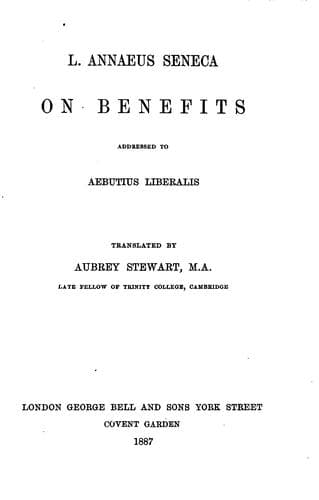
L. Annaeus Seneca on BenefitsSeneca, Lucius Annaeus
Philosophy
L. Annaeus Seneca on Benefits
Seneca, Lucius Annaeus
Benevolence; Classical literature; Conduct of life; Essays
she been saved otherwise, she would merely have received a common and
hackneyed piece of kindness, whereas, by being saved as she was, she
became a glorious legend, and an example to two cities. In the confusion
of the captured city, when every one was thinking only of his own
safety, all deserted her except these deserters; but they, that they
might prove what had been their intentions in effecting that desertion,
deserted again from the victors to the captive, wearing the masks of
unnatural murderers.
They thought--and this was the greatest part of the service which they
rendered--they were content to seem to have murdered their mistress, if
thereby their mistress might be saved from murder. Believe me, it is
the mark of no slavish soul to purchase a noble deed by the semblance of
crime.
When Vettius, the praetor of the Marsi, was being led into the presence
of the Roman general, his slave snatched a sword from the soldier who
was dragging him along, and first slew his master. Then he said, "It is
now time for me to look to myself; I have already set my master free,"
and with these words transfixed himself with one blow. Can you tell me
of anyone who saved his master more gloriously?
XXIV. When Caesar was besieging Corfinium, Domitius, who was shut up in
the city, ordered a slave of his own, who was also a physician, to give
him poison. Observing the man's hesitation, he said, "Why do you delay,
as though the whole business was in your power? I ask for death with
arms in my hands." Then the slave assented, and gave him a harmless drug
to drink. When Domitius fell asleep after drinking this, the slave went
to his son, and said, "Give orders for my being kept in custody until
you learn from the result whether I have given your father poison or
no." Domitius lived, and Caesar saved his life; but his slave had saved
it before.
XXV. During the civil war, a slave hid his master, who had been
proscribed, put on his rings and clothes, met the soldiers who were
searching for him, and, after declaring that he would not stoop to
entreat them not to carry out their orders, offered his neck to their
swords. What a noble spirit it shows in a slave to have been willing
to die for his master, at a time when few were faithful enough to
wish their master to live! to be found kind when the state was cruel,
faithful when it was treacherous! to be eager for the reward of
fidelity, though it was death, at a time when such rich rewards were
offered for treachery!
Public-domain text, read in full here on John Shaqi.
Reviews
Reviews
No reviews yet
Be the first to share your thoughts on this work.
Join the Discussion
Join the discussion
Sign in to leave a comment or review.
Sign InorCreate an account