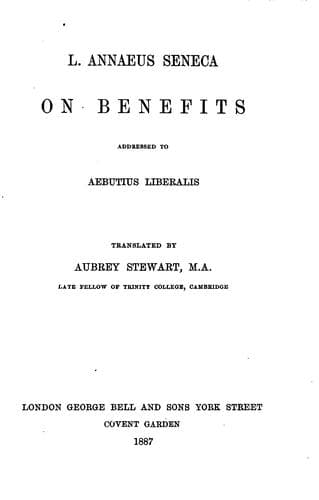
L. Annaeus Seneca on BenefitsSeneca, Lucius Annaeus
Philosophy
L. Annaeus Seneca on Benefits
Seneca, Lucius Annaeus
Benevolence; Classical literature; Conduct of life; Essays
XXXII. My father supported me. If I repay this kindness, I give him
more than I received, because he has the pleasure, not only of being
supported, but of being supported by a son, and receives more delight
from my filial devotion than from the food itself, whereas the food
which he used to give me merely affected my body. What? if any man
rises so high as to become famous among nations for his eloquence, his
justice, or his military skill, if much of the splendour of his renown
is shed upon his father also, and by its clear light dispels the
obscurity of his birth, does not such a man confer an inestimable
benefit upon his parents? Would anyone have heard of Aristo and Gryllus
except through Xenophon and Plato, their sons? Socrates keeps alive
the memory of Sophroniscus. It would take long to recount the other
men whose names survive for no other reason than that the admirable
qualities of their sons have handed them down to posterity. Did the
father of Marcus Agrippa, of whom nothing was known, even after Agrippa
became famous, confer the greater benefit upon his son, or was that
greater which Agrippa conferred upon his father when he gained the
glory, unique in the annals of war, of a naval crown, and when he raised
so many vast buildings in Rome, which not only surpassed all former
grandeur, but have been surpassed by none since? Did Octavius confer a
greater benefit upon his son, or the Emperor Augustus upon his father,
obscured as he was by the intervention of an adoptive father? What joy
would he have experienced, if, after the putting down of the civil war,
he had seen his son ruling the state in peace and security? He would not
have recognized the good which he had himself bestowed, and would hardly
have believed, when he looked back upon himself, that so great a man
could have been born in his house. Why should I go on to speak of others
who would now be forgotten, if the glory of their sons had not raised
them from obscurity, and kept them in the light until this day? In the
next place, as we are not considering what son may have given back to
his father greater benefits than he received from him, but whether a son
can give back greater benefits, even if the examples which I have quoted
are not sufficient, and such benefits do not outweigh the benefits
bestowed by the parents, if no age has produced. an actual example,
still it is not in the nature of things impossible. Though no solitary
act can outweigh the deserts of a parent, yet many such acts combined by
one son may do so.
Public-domain text, read in full here on John Shaqi.
Reviews
Reviews
No reviews yet
Be the first to share your thoughts on this work.
Elsewhere in the archive
Join the Discussion
Join the discussion
Sign in to leave a comment or review.
Sign InorCreate an account