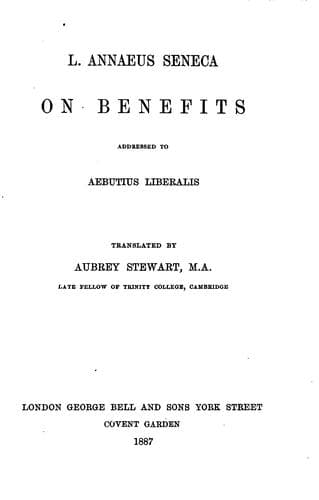
L. Annaeus Seneca on BenefitsSeneca, Lucius Annaeus
Philosophy
L. Annaeus Seneca on Benefits
Seneca, Lucius Annaeus
Benevolence; Classical literature; Conduct of life; Essays
XXXIII. Scipio, while under seventeen years of age, rode among the enemy
in battle, and saved his father's life. Was it not enough, that in order
to reach his father he despised so many dangers when they were pressing
hardest upon the greatest generals, that he, a novice in his first
battle, made his way through so many obstacles, over the bodies of so
many veteran soldiers, and showed strength and courage beyond his years?
Add to this, that he also defended his father in court, and saved him
from a plot of his powerful enemies, that he heaped upon him a second
and a third consulship and other posts which were coveted even by
consulars, that when his father was poor he bestowed upon him the
plunder which he took by military licence, and that he made him rich
with the spoils of the enemy, which is the greatest honour of a soldier.
If even this did not repay his debt, add to it that he caused him to
be constantly employed in the government of provinces and in special
commands, add, that after he had destroyed the greatest cities,
and became without a rival either in the east or in the west, the
acknowledged protector and second founder of the Roman Empire, he
bestowed upon one who was already of noble birth the higher title of
"the father of Scipio;" can we doubt that the commonplace benefit of his
birth was outdone by his exemplary conduct, and by the valour which was
at once the glory and the protection of his country? Next, if this
be not enough, suppose that a son were to rescue his father from the
torture, or to undergo it in his stead. You can suppose the benefits
returned by the son as great as you please, whereas the gift he received
from his father was of one sort only, was easily performed, and was
a pleasure to the giver; that he must necessarily have given the same
thing to many others, even to some to whom he knows not that he has
given it, that he had a partner in doing so, and that he had in view the
law, patriotism, the rewards bestowed upon fathers of families by the
state, the maintenance of his house and family: everything rather than
him to whom he was giving life. What? supposing that any one were to
learn philosophy and teach it to his father, could it be any longer
disputed that the son had given him something greater than he had
received from him, having returned to his father a happy life, whereas
he had received from him merely life?
Public-domain text, read in full here on John Shaqi.
Reviews
Reviews
No reviews yet
Be the first to share your thoughts on this work.
Elsewhere in the archive
Join the Discussion
Join the discussion
Sign in to leave a comment or review.
Sign InorCreate an account