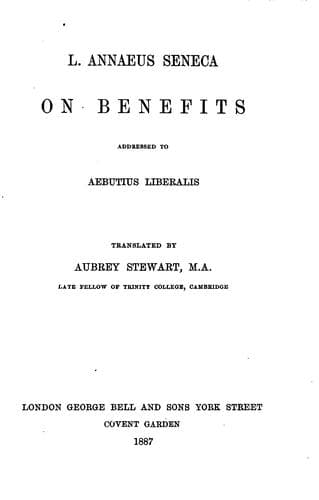
L. Annaeus Seneca on BenefitsSeneca, Lucius Annaeus
Philosophy
L. Annaeus Seneca on Benefits
Seneca, Lucius Annaeus
Benevolence; Classical literature; Conduct of life; Essays
XXXIV. "But," says our opponent, "whatever you do, whatever you are able
to give to your father, is part of his benefit bestowed upon you." So
it is the benefit of my teacher that I have become proficient in liberal
studies; yet we pass on from those who taught them to us, at any rate
from those who taught us the alphabet; and although no one can learn
anything without them, yet it does not follow that whatsoever success
one subsequently obtains, one is still inferior to those teachers. There
is a great difference between the beginning of a thing and its final
development; the beginning is not equal to the thing at its greatest,
merely upon the ground that, without the beginning, it could never have
become so great.
XXXV. It is now time for me to bring forth something, so to speak, from
my own mint. So long as there is something better than the benefit which
a man bestows, he may be outdone. A father gives life to his son;
there is something better than life; therefore a father may be outdone,
because there is something better than the benefit which he has
bestowed. Still further, he who has given any one his life, if he be
more than once saved from peril of death by him, has received a greater
benefit than he bestowed. Now, a father has given life to his son: if,
therefore, he be more than once saved from peril by his son, he can
receive a greater benefit than he gave. A benefit becomes greater to the
receiver in proportion to his need of it. Now he who is alive needs life
more than he who has not been born, seeing that such a one can have no
need at all; consequently a father, if his life is saved by his son,
receives a greater benefit than his son received from him by being born.
It is said, "The benefits conferred by fathers cannot be outdone by
those returned by their sons." Why? "Because the son received life from
his father, and had he not received it, he could not have returned any
benefits at all." A father has this in common with all those who have
given any men their lives; it is impossible that these men could repay
the debt if they had not received their life. Then I suppose one cannot
overpay one's debt to a physician, for a physician gives life as well
as a father; or to a sailor who has saved us when shipwrecked? Yet the
benefits bestowed by these and by all the others who give us life in
whatever fashion, can be outdone: consequently those of our fathers can
be outdone. If any one bestows upon me a benefit which requires the help
of benefits from many other persons, whereas I give him what requires no
one to help it out, I have given more than I have received; now a father
gave to his son a life which, without many accessories to preserve it,
would perish; whereas a son, if he gives life to his father, gives him
a life which requires no assistance to make it lasting; therefore the
father who receives life from his son, receives a greater benefit than
he himself bestowed upon his son.
Public-domain text, read in full here on John Shaqi.
Reviews
Reviews
No reviews yet
Be the first to share your thoughts on this work.
Elsewhere in the archive
Join the Discussion
Join the discussion
Sign in to leave a comment or review.
Sign InorCreate an account