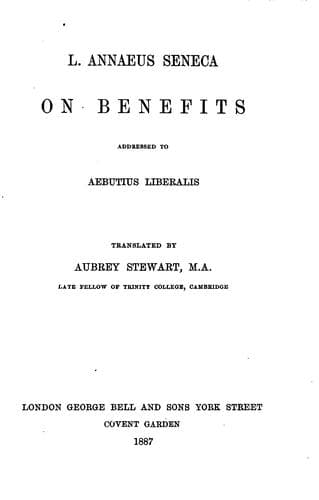
L. Annaeus Seneca on BenefitsSeneca, Lucius Annaeus
Philosophy
L. Annaeus Seneca on Benefits
Seneca, Lucius Annaeus
Benevolence; Classical literature; Conduct of life; Essays
XVI. These same adversaries of ours admit that they are grateful, yet
not because it is honourable, but because it is profitable to be so.
This can be proved to be untrue all the more easily, because it can be
established by the same arguments by which we have established that to
bestow a benefit is desirable for its own sake. All our arguments start
from this settled point, that honour is pursued for no reason except
because it is honour. Now, who will venture to raise the question
whether it be honourable to be grateful? who does not loathe the
ungrateful man, useless as he is even to himself? How do you feel when
any one is spoken of as being ungrateful for great benefits conferred
upon him by a friend? Is it as though he had done something base, or had
merely neglected to do something useful and likely to be profitable to
himself? I imagine that you think him a bad man, and one who deserves
punishment, not one who needs a guardian; and this would not be the
case, unless gratitude were desirable in itself and honourable. Other
qualities, it may be, manifest their importance less clearly, and
require an explanation to prove whether they be honourable or no; this
is openly proved to be so in the sight of all, and is too beautiful for
anything to obscure or dim its glory. What is more praiseworthy, upon
what are all men more universally agreed, than to return gratitude for
good offices?
XVII. Pray tell me, what is it that urges us to do so? Is it profit?
Why, unless a man despises profit, he is not grateful. Is it ambition?
why, what is there to boast of in having paid what you owe? Is it
fear? The ungrateful man feels none, for against this one crime we
have provided no law, as though nature had taken sufficient precautions
against it. Just as there is no law which bids parents love and indulge
their children, seeing that it is superfluous to force us into the
path which we naturally take, just as no one needs to be urged to love
himself, since self-love begins to act upon him as soon as he is born,
so there is no law bidding us to seek that which is honourable
in itself; for such things please us by their very nature, and so
attractive is virtue that the disposition even of bad men leads them to
approve of good rather than of evil. Who is there who does not wish
to appear beneficent, who does not even when steeped in crime and
wrong-doing strive after the appearance of goodness, does not put some
show of justice upon even his most intemperate acts, and endeavour to
seem to have conferred a benefit even upon those whom he has injured?
Consequently, men allow themselves to be thanked by those whom they have
ruined, and pretend to be good and generous, because they cannot prove
themselves so; and this they never would do were it not that a love
of honour for its own sake forces them to seek a reputation quite at
variance with their real character, and to conceal their baseness, a
Public-domain text, read in full here on John Shaqi.
Reviews
Reviews
No reviews yet
Be the first to share your thoughts on this work.
Elsewhere in the archive
Join the Discussion
Join the discussion
Sign in to leave a comment or review.
Sign InorCreate an account