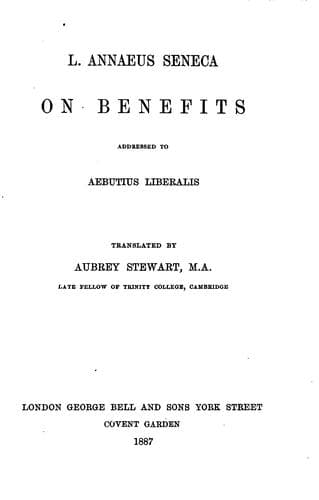
L. Annaeus Seneca on BenefitsSeneca, Lucius Annaeus
Philosophy
L. Annaeus Seneca on Benefits
Seneca, Lucius Annaeus
Benevolence; Classical literature; Conduct of life; Essays
XIX. No sane man fears the gods; for it is madness to fear what is
beneficial, and no man loves those whom he fears. You, Epicurus, ended
by making God unarmed; you stripped him of all weapons, of all power,
and, lest anyone should fear him, you banished him out of the world.
There is no reason why you should fear this being, cut off as he is, and
separated from the sight and touch of mortals by a vast and impassable
wall; he has no power either of rewarding or of injuring us; he dwells
alone half-way between our heaven and that of another world, without the
society either of animals, of men, or of matter, avoiding the crash of
worlds as they fall in ruins above and around him, but neither hearing
our prayers nor interested in us. Yet you wish to seem to worship this
being just as a father, with a mind, I suppose, full of gratitude; or,
if you do not wish to seem grateful, why should you worship him, since
you have received no benefit from him, but have been put together
entirely at random and by chance by those atoms and mites of yours?
"I worship him," you answer, "because of his glorious majesty and his
unique nature." Granting that you do this, you clearly do it without
the attraction of any reward, or any hope; there is therefore something
which is desirable for itself, whose own worth attracts you, that
is, honour. Now what is more honourable than gratitude? the means of
practising this virtue are as extensive as life itself.
XX. "Yet," argues he, "there is also a certain amount of profit inherent
in this virtue." In what virtue is there not? But that which we speak
of as desirable for itself is such, that although it may possess some
attendant advantages, yet it would be desirable even if stripped of
all these. It is profitable to be grateful; yet I will be grateful even
though it harm me. What is the aim of the grateful man? is it that his
gratitude may win for him more friends and more benefits? What then? If
a man is likely to meet with affronts by showing his gratitude, if he
knows that far from gaining anything by it, he must lose much even of
what he has already acquired, will he not cheerfully act to his own
disadvantage? That man is ungrateful who, in returning a kindness,
looks forward to a second gift--who hopes while he repays. I call him
ungrateful who sits at the bedside of a sick man because he is about
to make a will, when he is at leisure to think of inheritances and
legacies. Though he may do everything which a good and dutiful friend
ought to do, yet, if any hope of gain be floating in his mind, he is a
mere legacy-hunter, and is angling for an inheritance. Like the birds
which feed upon carcases, which come close to animals weakened by
disease, and watch till they fall, so these men are attracted by death
and hover around a corpse.
Public-domain text, read in full here on John Shaqi.
Reviews
Reviews
No reviews yet
Be the first to share your thoughts on this work.
Elsewhere in the archive
Join the Discussion
Join the discussion
Sign in to leave a comment or review.
Sign InorCreate an account