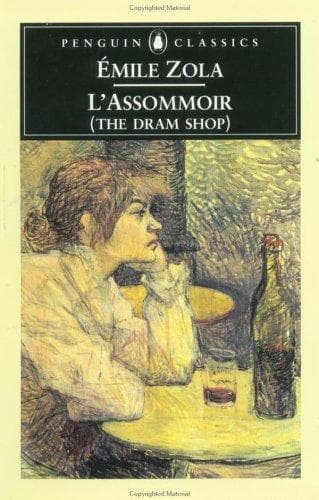
Domestic fiction; Married women -- Fiction; Paris (France) -- Fiction; Working class women -- Fiction
Meanwhile, Pere Bru had followed Gervaise into the room. Between them
they were trying to get him towards the door. But he turned round,
speechless and foaming at the lips, and in his pale eyes the alcohol
was blazing with a murderous glare. The laundress had her wrist
injured; the old workman was knocked against the table. On the floor,
Madame Bijard was breathing with greater difficulty, her mouth wide
open, her eyes closed. Now Bijard kept missing her. He had madly
returned to the attack, but blinded by rage, his blows fell on either
side, and at times he almost fell when his kicks went into space. And
during all this onslaught, Gervaise beheld in a corner of the room
little Lalie, then four years old, watching her father murdering her
mother. The child held in her arms, as though to protect her, her
sister Henriette, only recently weaned. She was standing up, her head
covered with a cotton cap, her face very pale and grave. Her large
black eyes gazed with a fixedness full of thought and were without a
tear.
When at length Bijard, running against a chair, stumbled onto the tiled
floor, where they left him snoring, Pere Bru helped Gervaise to raise
Madame Bijard. The latter was now sobbing bitterly; and Lalie, drawing
near, watched her crying, being used to such sights and already
resigned to them. As the laundress descended the stairs, in the silence
of the now quieted house, she kept seeing before her that look of this
child of four, as grave and courageous as that of a woman.
“Monsieur Coupeau is on the other side of the street,” called out
Clemence as soon as she caught sight of her. “He looks awfully drunk.”
Coupeau was just then crossing the street. He almost smashed a pane of
glass with his shoulder as he missed the door. He was in a state of
complete drunkenness, with his teeth clinched and his nose inflamed.
And Gervaise at once recognized the vitriol of l’Assommoir in the
poisoned blood which paled his skin. She tried to joke and get him to
bed, the same as on the days when the wine had made him merry; but he
pushed her aside without opening his lips, and raised his fist in
passing as he went to bed of his own accord. He made Gervaise think of
the other—the drunkard who was snoring upstairs, tired out by the blows
he had struck. A cold shiver passed over her. She thought of the men
she knew—of her husband, of Goujet, of Lantier—her heart breaking,
despairing of ever being happy.
CHAPTER VII.
Public-domain text, read in full here on John Shaqi.
Reviews
Reviews
No reviews yet
Be the first to share your thoughts on this work.
Elsewhere in the archive
Join the Discussion
Join the discussion
Sign in to leave a comment or review.
Sign InorCreate an account