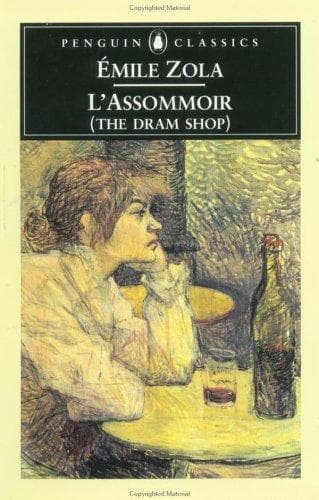
Domestic fiction; Married women -- Fiction; Paris (France) -- Fiction; Working class women -- Fiction
Ah! yes; Gervaise had finished her day! She was wearier even than all
this mob of toilers who had jostled her as they went by. She might lie
down there and croak, for work would have nothing more to do with her,
and she had toiled enough during her life to say: “Whose turn now? I’ve
had enough.” At present everyone was eating. It was really the end, the
sun had blown out its candle, the night would be a long one. _Mon
Dieu!_ To stretch one’s self at one’s ease and never get up again; to
think one had put one’s tools by for good and that one could ruminate
like a cow forever! That’s what is good, after tiring one’s self out
for twenty years! And Gervaise, as hunger twisted her stomach, thought
in spite of herself of the fete days, the spreads and the revelry of
her life. Of one occasion especially, an awfully cold day, a mid-Lent
Thursday. She had enjoyed herself wonderfully well. She was very
pretty, fair-haired and fresh looking at that time. Her wash-house in
the Rue Neuve had chosen her as queen in spite of her leg. And then
they had had an outing on the boulevards in carts decked with greenery,
in the midst of stylish people who ogled her. Real gentlemen put up
their glasses as if she had been a true queen. In the evening there was
a wonderful spread, and then they had danced till daylight. Queen; yes
Queen! With a crown and a sash for twenty-four hours—twice round the
clock! And now oppressed by hunger, she looked on the ground, as if she
were seeking for the gutter in which she had let her fallen majesty
tumble.
She raised her eyes again. She was in front of the slaughter-houses
which were being pulled down; through the gaps in the facade one could
see the dark, stinking courtyards, still damp with blood. And when she
had gone down the Boulevard again, she also saw the Lariboisiere
Hospital, with its long grey wall, above which she could distinguish
the mournful, fan-like wings, pierced with windows at even distances. A
door in the wall filled the neighborhood with dread; it was the door of
the dead in solid oak, and without a crack, as stern and as silent as a
tombstone. Then to escape her thoughts, she hurried further down till
she reached the railway bridge. The high parapets of riveted sheet-iron
hid the line from view; she could only distinguish a corner of the
station standing out against the luminous horizon of Paris, with a vast
roof black with coal-dust. Through the clear space she could hear the
engines whistling and the cars being shunted, in token of colossal
hidden activity. Then a train passed by, leaving Paris, with puffing
breath and a growing rumble. And all she perceived of this train was a
white plume, a sudden gust of steam which rose above the parapet and
then evaporated. But the bridge had shaken, and she herself seemed
impressed by this departure at full speed. She turned round as if to
follow the invisible engine, the noise of which was dying away.
Public-domain text, read in full here on John Shaqi.
Reviews
Reviews
No reviews yet
Be the first to share your thoughts on this work.
Elsewhere in the archive
Join the Discussion
Join the discussion
Sign in to leave a comment or review.
Sign InorCreate an account