_Les Destins de la Vendée_. 1819.
_Sur Walter Scott_. 1823.
_Sur Lord Byron_ (à propos de sa mort). 1824.
_Guerre aux démolisseurs_. 1825-32.
_Journal des idées et des opinions d'un révolutionnaire de 1830_.
_Sur Mirabeau_. 1834.
_La Libération du territoire_. 1873.
Many political articles, speeches, and prefaces.
IV
STUDY AND CRITICISM.
The studies and criticisms on Hugo form a large and ever-increasing
library. The most remarkable among them are the following:
SAINTE-BEUVE. _Critiques et Portraits littéraires_. Articles on Victor
Hugo. 1832.
GUSTAVE PLANCHE. _Nouveaux portraits littéraires_. Studies and
criticisms on some of Hugo's plays. 1832-8.
_Revue des Deux Mondes_, passim. Articles by Gustave Planche, A.
Fontaney, and Charles Magnin.
CHARLES ASSELINEAU. _Mélanges d'une bibliothèque romantique_. 1867.
LEONARD DE LOMÉNIE. _Galerie des contemporains illustres_. Vol. I. 1879.
GUSTAVE DESSOFFY (le comte). _Discours sur la vie littéraire de Victor
Hugo_. 1845.
ELISA CHEVALIER. _La Vérité sur Victor Hugo_. 1850.
EUGÈNE DE MIRECOURT. _Victor Hugo_. 1854.
HIPPOLYTE CASTILLE. _Victor Hugo_.
A. MAZURE. _Les Poètes contemporains_.
ERNEST HAMEL. _Victor Hugo_. 1860.
ALFRED NETTEMENT. _Victor Hugo_. 1862.
MADAME VICTOR HUGO. _Victor Hugo, raconté par un témoin de sa vie_. 2
vols. 1863.
PAUL DE SAINT-VICTOR. _Victor Hugo_. 1885.
E. Dupuis. _Victor Hugo, l'homme et le poète_. 1897.
PETIT DE JULLEVILLE. _Histoire de la littérature française_. 1894-1900.
CH. RENOUVIER. _Victor Hugo, le Poète et le philosophe_. 2 vols. 1900.
A. SLEUMER. _Die Dramen von Hugo_. Berlin, 1901.
GASTON DESCHAMPS. _Conférences sur Victor Hugo_. 1898.
ÉMILE FAGUET. _Histoire de la littérature française_. 1900.
And a host of articles by such critics as Émile Montégut, Émile Augier,
Edmond Scherer, without speaking of the innumerable notes and criticisms
which have appeared on Hugo and his work in daily papers and periodicals
both in France and in foreign countries.
V.
PORTRAITS.
These are extremely numerous, but previously to 1851, that is, before
Hugo left France, they all represent him as a clean-shaven man. After
his exile Hugo grew a beard, hence the alteration so noticeable in the
portraits subsequent to 1851.
The portrait chosen represents Hugo in his youth, at the time of the
first appearance of _Notre-Dame de Paris_.
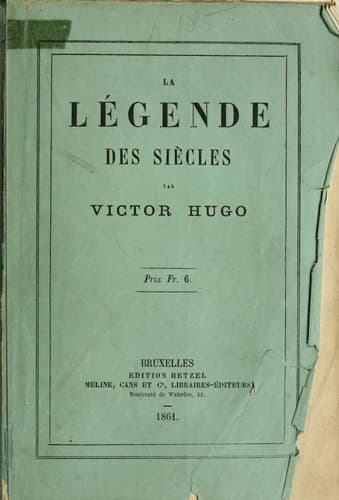
End of the Project Gutenberg EBook of La Légende des Siècles, by Victor Hugo
Public-domain text, read in full here on John Shaqi.
Reviews
Reviews
No reviews yet
Be the first to share your thoughts on this work.
Elsewhere in the archive
Join the Discussion
Join the discussion
Sign in to leave a comment or review.
Sign InorCreate an account