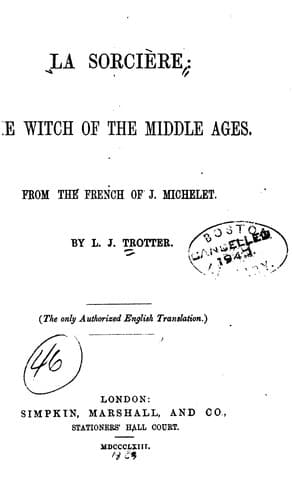
La Sorcière: The Witch of the Middle AgesMichelet, Jules
History
La Sorcière: The Witch of the Middle Ages
Michelet, Jules
Demonomania -- History -- To 1500; Satanism -- History -- To 1500; Superstition -- History -- To 1500; Witchcraft -- History -- To 1500
The judge who burns them is charmed with them, nevertheless. “When you
see them pass,” says he, “their hair flowing in the breeze about their
shoulders, they walk so trim, so bravely armed in that fair
head-dress, that the sun playing through it as through a cloud, causes
a mighty blaze which shoots forth hot lightning-flashes. Hence the
fascination of their eyes, as dangerous in love as in witchcraft.”
This amiable Bordeaux magistrate, the earliest sample of those worldly
judges who enlivened the gown in the seventeenth century, plays the
lute between whiles, and even makes the witches dance before sending
them to the stake. And he writes well, far more clearly than anyone
else. But for all that, one discovers in his work a new source of
obscurity, inherent to those times. The witches being too numerous for
the judge to burn them all, the most of them have a shrewd idea that
he will show some indulgence to those who enter deepest into his
thoughts and passions! What passions? you ask. First, his love of the
frightfully marvellous, a passion common enough; the delight of
feeling afraid; and also, if it must be said, the enjoyment of
unseemly pleasures. Add to these a touch of vanity: the more dreadful
and enraged those clever women show the Devil to be, the greater the
pride taken by the judge in subduing so mighty an adversary. He arrays
himself as it were in his victory, enthrones himself in his
foolishness, triumphs in his senseless twaddling.
The prettiest thing of this kind is the report of the procedure in the
Spanish _auto-da-fé_ of Logroño, as furnished to us by Llorente.
Lancre, while quoting him jealously and longing to disparage him, owns
to the surpassing charm of the festival, the splendour of the sight,
the moving power of the music. On one platform were the few condemned
to the flames, on another a crowd of reprieved criminals. The
confession of a repentant heroine who had dared all things, is read
aloud. Nothing could be wilder. At the Sabbaths they ate children made
into hash, and by way of second course, the bodies of wizards
disentombed. Toads dance, and talk and complain lovingly of their
mistresses, getting them scolded by the Devil. The latter politely
escorts the witches home, lighting them with the arm of a child who
died unchristened, &c.
Among our Basques witchcraft put on a less fantastic guise. It seems
that at this time the Sabbath was only a grand feast to which all, the
nobles included, went for purposes of amusement. In the foremost line
would be seen persons in veils and masks, by some supposed to be
princes. “Once on a time,” says Lancre, “none but idiots of the Landes
appeared there: now people of quality are seen to go.” To entertain
these local grandees, Satan sometimes created a _Bishop of the
Sabbath_. Such was the title he gave the young lord Lancinena, with
whom the Devil in person was good enough to open the ball.
Public-domain text, read in full here on John Shaqi.
Reviews
Reviews
No reviews yet
Be the first to share your thoughts on this work.
Elsewhere in the archive
Join the Discussion
Join the discussion
Sign in to leave a comment or review.
Sign InorCreate an account