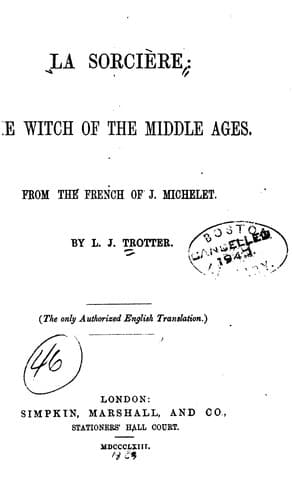
La Sorcière: The Witch of the Middle AgesMichelet, Jules
History
La Sorcière: The Witch of the Middle Ages
Michelet, Jules
Demonomania -- History -- To 1500; Satanism -- History -- To 1500; Superstition -- History -- To 1500; Witchcraft -- History -- To 1500
Gauffridi seems to have been a talented, agreeable man. Born in the
mountains of Provence, he had travelled much in the Low Countries and
the East. He bore the highest character in Marseilles, where he served
as priest in the Church of Acoules. His bishop made much of him: the
most devout of the ladies preferred him for their confessor. He had a
wondrous gift, they say, of endearing himself to all. Nevertheless, he
might have preserved his fair reputation had not a noble lady of
Provence, whom he had already debauched, carried her blind, doting
fondness to the extent of entrusting him, perhaps for her religious
training, with the care of a charming child of twelve, Madeline de la
Palud, a girl of fair complexion and gentle nature. Thereon, Gauffridi
lost his wits, and respected neither the youth nor the holy ignorance,
the utter unreserve of his pupil.
As she grew older, however, the young highborn girl discovered her
misfortune, in loving thus beneath her, without hope of marriage. To
keep his hold on her, Gauffridi vowed he would wed her before the
Devil, if he might not wed her before God. He soothed her pride by
declaring that he was the Prince of Magicians, and would make her his
queen. He put on her finger a silver ring, engraved with magic
characters. Did he take her to the Sabbath, or only make her believe
she had been there, by confusing her with strange drinks and magnetic
witcheries? Certain it is, at least, that torn by two different
beliefs, full of uneasiness and fear, the girl thenceforth became mad
at certain times, and fell into fits of epilepsy. She was afraid of
being carried off alive by the Devil. She durst no longer stay in her
father’s house, and took shelter in the Ursuline Convent at
Marseilles.
CHAPTER VI.
GAUFFRIDI: 1610.
The order of Ursuline nuns seemed to be the calmest, the least
irrational of them all. They were not wholly idle, but found some
little employment in the bringing up of young girls. The Catholic
reaction which, aiming at a higher flight of ecstasy than was possible
at that time even in Spain, had foolishly built a number of convents,
Carmelite, Bernardine, and Capuchin, soon found itself at the end of
its motive-powers. The girls of whom people got rid by shutting them
up so strictly therein, died off immediately, and their swift decease
led to frightful statements of the cruelty shown by their families.
They perished, indeed, not by their excessive penances, but rather of
heart-sickness and despair. After the first heats of zeal were over,
the dreadful disease of the cloister, described by Cassieu as dating
from the fifteenth century, that crushing, sickening sadness which
came on of an afternoon--that tender listlessness which plunged them
into a state of unutterable exhaustion, speedily wore them away. A few
among them would turn as if raging mad, choking, as it were, with the
exceeding strength of their blood.
Public-domain text, read in full here on John Shaqi.
Reviews
Reviews
No reviews yet
Be the first to share your thoughts on this work.
Elsewhere in the archive
Join the Discussion
Join the discussion
Sign in to leave a comment or review.
Sign InorCreate an account