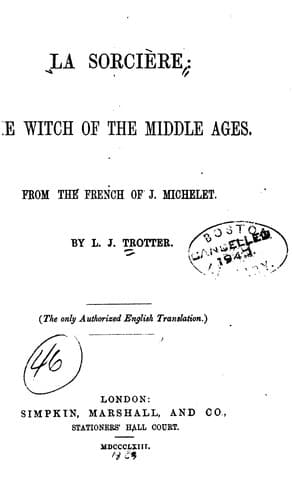
La Sorcière: The Witch of the Middle AgesMichelet, Jules
History
La Sorcière: The Witch of the Middle Ages
Michelet, Jules
Demonomania -- History -- To 1500; Satanism -- History -- To 1500; Superstition -- History -- To 1500; Witchcraft -- History -- To 1500
That heart indeed woke up at the guilty one’s approach: for one moment
the furious woman seemed to grow tender. I know nothing more fiery
than her prayer for God to save the man she has driven to death:
“Great God, I offer thee all the sacrifices that have been offered
since the world began, that will be offered until it ends. All, all,
for Lewis. I offer thee all the tears of every saint, all the
transports of every angel. All, all, for Lewis. Oh, that there were
yet more souls to reckon up, that so the oblation might be all the
greater! It should be all for Lewis. O God, the Father of Heaven, have
pity on Lewis! O God the Son, Redeemer of the world, have pity on
Lewis!” &c.
Bootless pity! baneful as well as bootless! Her real desire was that
the accused _should not harden his heart_, should plead guilty. In
that case by our laws he would most assuredly be burnt.
She herself, in short, was worn out, unable to do anything more. The
inquisitor Michaëlis was so humbled by a victory he could not have
gained without her, so wroth with the Flemish exorciser who had become
her obedient follower, and let her see into all the hidden springs of
the tragedy, that he came simply to crush Louisa, and save Madeline by
substituting the one for the other, if he could, in this popular
drama. This move of his implies some skill, and a knowing eye for
scenery. The winter and the Advent season had been wholly taken up
with the acting of that awful sibyl, that raging bacchante. In the
milder days of a Provencial spring, in the season of Lent, he would
bring upon the scene a more moving personage, a demon all womanly,
dwelling in a sick child, in a fair-haired frightened girl. The nobles
and the Parliament of Provence would feel an interest in a little lady
who belonged to an eminent house.
Far from listening to his Flemish agent, Louisa’s follower, Michaëlis
shut the door upon him when he sought to enter the select council of
Parliament-men. A Capuchin who also came, on the first words spoken by
Louisa, cried out, “Silence, accursed devil!”
Meanwhile Gauffridi had arrived at Sainte-Baume, where he cut a sorry
figure. A man of sense, but weak and blameworthy, he foreboded but too
truly how that kind of popular tragedy would end; and in coming to a
strait so dreadful, he saw himself forsaken and betrayed by the child
he loved. He now entirely forsook himself. When he was confronted with
Louisa, she seemed to him like a judge, like one of those cruel and
subtle schoolmen who judged the causes of the Church. To all her
questions concerning doctrine, he only answered _yes_, assenting even
to points most open to dispute; as, for instance, to the assumption
“that the Devil in a court of justice might be believed on his word
and his oath.”
Public-domain text, read in full here on John Shaqi.
Reviews
Reviews
No reviews yet
Be the first to share your thoughts on this work.
Elsewhere in the archive
Join the Discussion
Join the discussion
Sign in to leave a comment or review.
Sign InorCreate an account