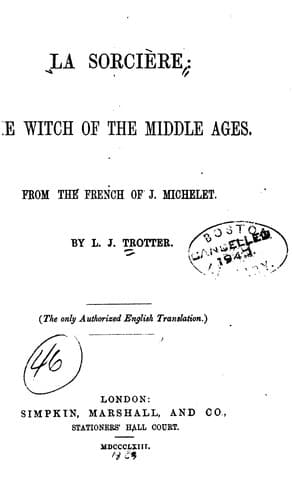
La Sorcière: The Witch of the Middle AgesMichelet, Jules
History
La Sorcière: The Witch of the Middle Ages
Michelet, Jules
Demonomania -- History -- To 1500; Satanism -- History -- To 1500; Superstition -- History -- To 1500; Witchcraft -- History -- To 1500
The little town was all in a tremble. Monks of every hue provided
themselves with nuns, shared them all round, and exorcised them by
threes and fours. The churches were parcelled out among them; the
Capuchins alone taking two for themselves. The crowd go after them,
swollen by all the women in the place, and in this frightened
audience, throbbing with anxiety, more than one cries out that she,
too, is feeling the devils.[95] Six girls of the town are possessed.
And the bare recital of these alarming events begets two new cases of
possession at Chinon.
[95] The same hysteric contagion marks the “Revivals” of a
later period, down to the last mad outbreak in Ireland. The
translator hopes some day to work out the physical question
here stated.--TRANS.
Everywhere the thing was talked of, at Paris, at the Court. Our
Spanish queen,[96] who is imaginative and devout, sends off her
almoner; nay more, sends her faithful follower, the old papist, Lord
Montague, who sees, who believes everything, and reports it all to the
Pope. It is a miracle proven. He had seen the wounds on a certain nun,
and the marks made by the Devil on the Lady Superior’s hands.
[96] Anne of Austria, wife of Louis XIII.--TRANS.
What said the King of France to this? All his devotion was turned on
the Devil, on hell, on thoughts of fear. It is said that Richelieu was
glad to keep him thus. I doubt it; the demons were essentially
Spanish, taking the Spanish side: if ever they talked politics, they
must have spoken against Richelieu. Perhaps he was afraid of them. At
any rate, he did them homage, and sent his niece to prove the interest
he took in the matter.
* * * * *
The Court believed, but Loudun itself did not. Its devils, but sorry
imitators of the Marseilles demons, rehearsed in the morning what they
had learnt the night before from the well-known handbook of Father
Michaëlis. They would never have known what to say but for the secret
exorcisms, the careful rehearsal of the day’s farce, by which night
after night they were trained to figure before the people.
One sturdy magistrate, bailiff of the town, made a stir: going himself
to detect the knaves, he threatened and denounced them. Such, too, was
the tacit opinion of the Archbishop of Bordeaux, to whom Grandier
appealed. He despatched a set of rules for the guidance at least of
the exorcisers, for putting a stop to their arbitrary doings; and,
better still, he sent his surgeon, who examined the girls, and found
them to be neither bewitched, nor mad, nor even sick. What were they
then? Knaves, to be sure.[97]
[97] Not of necessity knaves, Mr. Michelet; at least not
wilfully so; but silly hysteric patients, of the
spirit-rapping, revivalist order, victims of nervous
derangement, or undue nervous sensibility.--TRANS.
Public-domain text, read in full here on John Shaqi.
Reviews
Reviews
No reviews yet
Be the first to share your thoughts on this work.
Elsewhere in the archive
Join the Discussion
Join the discussion
Sign in to leave a comment or review.
Sign InorCreate an account