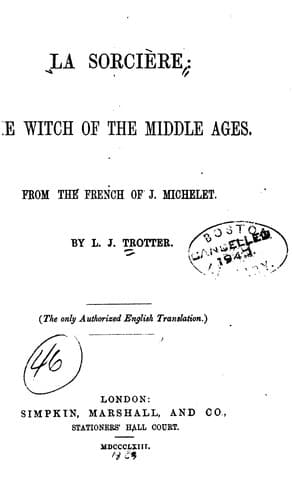
La Sorcière: The Witch of the Middle AgesMichelet, Jules
History
La Sorcière: The Witch of the Middle Ages
Michelet, Jules
Demonomania -- History -- To 1500; Satanism -- History -- To 1500; Superstition -- History -- To 1500; Witchcraft -- History -- To 1500
It is stated that Father Joseph, after a secret journey to the spot,
saw to what end the matter was coming, and noiselessly backed out of
it. The Jesuits also went, tried their exorcisms, did next to nothing,
got scent of the general feeling, and stole off in like manner.
But the monks, the Capuchins, were gone so far, that they could only
save themselves by frightening others. They laid some treacherous
snares for the daring bailiff and his wife, seeking to destroy them,
and thereby quench the coming reaction of justice. Lastly, they urged
on the commissioners to despatch Grandier. Things could be carried no
further: the nuns themselves were slipping out of their hands. After
that dreadful orgie of sensual rage and immodest shouting in order to
obtain the shedding of human blood, two or three of them swooned away,
were seized with disgust and horror; vomited up their very selves.
Despite the hideous doom that awaited them if they spoke the truth,
despite the certainty of ending their days in a dungeon, they owned in
church that they were damned, that they had been playing with the
Devil, and Grandier was innocent.
* * * * *
They ruined themselves, but could not stay the issue. A general
protest by the town to the King failed to stay it also. On the 18th
August, 1634, Grandier was condemned to the stake. So violent were his
enemies that, for the second time before burning him, they insisted on
having him stuck with needles in order to find out the Devil’s marks.
One of his judges would have had even his nails torn out of him, had
not the surgeon withheld his leave.
They were afraid of the last words their victim might say on the
scaffold. Among his papers there had been found a manuscript
condemning the celibacy of priests, and those who called him a wizard
themselves believed him to be a freethinker. They remembered the brave
words which the martyrs of free thought had thrown out against their
judges; they called to mind the last speech of Giordano Bruno, the
bold defiance of Vanini.[101] So they agreed with Grandier, that if he
were prudent, he should be saved from burning, perhaps be strangled.
The weak priest, being a man of flesh, yielded to this demand of the
flesh, and promised to say nothing. He spoke not a word on the road,
nor yet upon the scaffold. When he was fairly fastened to the post,
with everything ready, and the fire so arranged as to enfold him
swiftly in smoke and flames, his own confessor, a monk, set the
faggots ablaze without waiting for the executioner. The victim,
pledged to silence, had only time to say, “So, you have deceived me!”
when the flames whirled fiercely upwards, and the furnace of pain
began, and nothing was audible save the wretch’s screams.
[101] Both Neapolitans, burnt alive, the former at Venice in
1600, the latter at Toulouse in 1619.--TRANS.
Public-domain text, read in full here on John Shaqi.
Reviews
Reviews
No reviews yet
Be the first to share your thoughts on this work.
Elsewhere in the archive
Join the Discussion
Join the discussion
Sign in to leave a comment or review.
Sign InorCreate an account