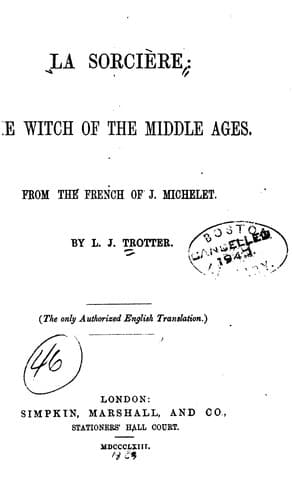
La Sorcière: The Witch of the Middle AgesMichelet, Jules
History
La Sorcière: The Witch of the Middle Ages
Michelet, Jules
Demonomania -- History -- To 1500; Satanism -- History -- To 1500; Superstition -- History -- To 1500; Witchcraft -- History -- To 1500
Not less unwilling was she to uncover her soul, to confess to the Lady
Superior, after the usual monastic custom of which the abbesses were
particularly fond. She would rather trust herself with old David, who
kept her apart from the rest. He himself confided his own ailments
into her ear. Nor did he hide from her his inner teaching, the
Illuminism, which governed the convent: “You must kill sin by being
made humble and lost to all sense of pride through sin.” Madeline was
frightened at the depths of depravity reached by the nuns, who quietly
carried out the teaching with which they had been imbued. She avoided
their company, kept to herself, and succeeded in getting made one of
the doorkeepers.
* * * * *
David died when she was eighteen. Old age prevented his going far with
the girl. But the vicar Picart, who succeeded him, was furious in his
pursuit of her; at the confessional spoke to her only of his love. He
made her his sextoness, that he might meet her alone in chapel. She
liked him not; but the nuns forbade her to have another confessor,
lest she might divulge their little secrets. And thus she was given
over to Picart. He beset her when she was sick almost to death;
seeking to frighten her by insisting that from David he had received
some infernal prescriptions. He sought to win her compassion by
feigning illness and begging her to come and see him. Thenceforth he
became her master, upset her mind with magic potions, and worked her
into believing that she had gone with him to the Sabbath, there to
officiate as altar and victim. At length, exceeding even the Sabbath
usages and daring the scandal that would follow, he made her to be
with child.
The nuns were afraid of one who knew the state of their morals; and
their interest also bound them to him. The convent was enriched by his
energy, his good repute, the alms and gifts he attracted towards it
from every quarter. He was building them a large church. We saw in the
Loudun business by what rivalries and ambitions these houses were led
away, how jealously they strove each to outdo the others. Through the
trust reposed in him by the wealthy, Picart saw himself raised into
the lofty part of benefactor and second founder of the convent.
“Sweetheart,” he said to Madeline, “that noble church is all my
building! After my death you will see wonders wrought there. Do you
not agree to that?”
This fine gentleman did not put himself out at all regarding Madeline.
He paid a dowry for her, and made a nun of her who was already a
lay-sister. Thus, being no longer a doorkeeper, she could live in one
of the inner rooms, and there be brought to bed at her convenience. By
means of certain drugs, and practices of their own, the convents could
do without the help of doctors. Madeline said that she was delivered
several times. She never said what became of the newly-born.
Public-domain text, read in full here on John Shaqi.
Reviews
Reviews
No reviews yet
Be the first to share your thoughts on this work.
Elsewhere in the archive
Join the Discussion
Join the discussion
Sign in to leave a comment or review.
Sign InorCreate an account