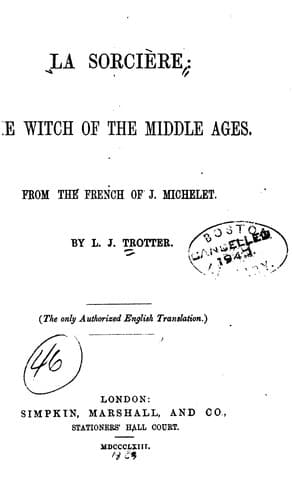
La Sorcière: The Witch of the Middle AgesMichelet, Jules
History
La Sorcière: The Witch of the Middle Ages
Michelet, Jules
Demonomania -- History -- To 1500; Satanism -- History -- To 1500; Superstition -- History -- To 1500; Witchcraft -- History -- To 1500
Among the fifty-two nuns, said he, there were six _possessed_, but
deserving of chastisement. Seventeen more were victims under a spell,
a pack of girls upset by the disease of the cloisters. He describes
it with great precision: the girls are regular but hysterical, blown
out with certain inward storms, lunatics mainly, and disordered in
mind. A nervous contagion has ruined them; and the first thing to do
is to keep them apart.
He then, with the liveliness of Voltaire, examines the tokens by which
the priests were wont to recognize the supernatural character of the
bewitched. They foretel, he allows, but only what never happens. They
translate, indeed, but without understanding; as when, for instance,
they render “_ex parte virginis_,” by “the departure of the Virgin.”
They know Greek before the people of Louviers, but cannot speak it
before the doctors of Paris. They cut capers, take leaps of the
easiest kind, climb up the trunk of a tree which a child three years
old might climb. In short, the only thing they do that is really
dreadful and unnatural, is to use dirtier language than men would ever
do.
* * * * *
In tearing off the mask from these people, the surgeon rendered a
great service to humanity. For the matter was being pushed further;
other victims were about to be made. Besides the charms were found
some papers, ascribed to David or Picart, in which this and that
person were called witches, and marked out for death. Each one
shuddered lest his name should be found there. Little by little the
fear of the priesthood made its way among the people.
The rotten age of Mazarin, the first days of the weak Anne of Austria,
were already come. Order and government were no more. “But one phrase
was left in the language: _The Queen is so good._” Her goodness gave
the clergy a chance of getting the upper hand. The power of the laity
entombed with Richelieu, bishops, priests, and monks, were about to
reign. The bold impiety of the magistrate and his friend Yvelin
imperilled so sweet a hope. Groans and wailings went forth to the Good
Queen, not from the victims, but from the knaves thus caught in the
midst of their offences. Up to the Court they went, weeping for the
outrage to their religion.
Yvelin was not prepared for this stroke: he deemed himself firm at
Court, having for ten years borne the title of Surgeon to the Queen.
Before he returned from Louviers to Paris, the weakness of Anne of
Austria had been tempted into granting another commission named by his
opponents, consisting of an old fool in his dotage, one Diafoirus of
Rouen, and his nephew, both attached to the priesthood. These did not
fail to discover that the Louviers affair was supernatural,
transcending all art of man.
Public-domain text, read in full here on John Shaqi.
Reviews
Reviews
No reviews yet
Be the first to share your thoughts on this work.
Elsewhere in the archive
Join the Discussion
Join the discussion
Sign in to leave a comment or review.
Sign InorCreate an account