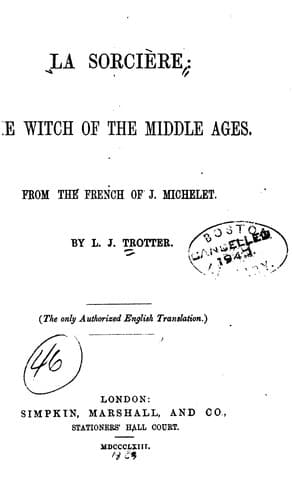
La Sorcière: The Witch of the Middle AgesMichelet, Jules
History
La Sorcière: The Witch of the Middle Ages
Michelet, Jules
Demonomania -- History -- To 1500; Satanism -- History -- To 1500; Superstition -- History -- To 1500; Witchcraft -- History -- To 1500
Observe that all three, agreeing as they do wonderfully together, were
printed at Aix under the eye of her enemies, in a volume where, as I
shall presently prove, an attempt was made to extenuate the guilt of
Girard, and fasten the reader’s gaze on every point likely to tell
against Cadière. And yet the editor could not help inserting
depositions like these, which bear with crushing weight on the man he
sought to uphold.
It was a monstrous piece of inconsistency on Girard’s part. He first
frightened the poor girl, and then suddenly took a base, a cruel
advantage of her fears.
In this case no plea of love can be offered in extenuation. The truth
is far otherwise: he loved her no more. And this forms the most
dreadful part of the story. We have seen how cruelly he drugged her;
we have now to see her utterly forsaken. He owed her a grudge for
being of greater worth than those other degraded women. He owed her a
grudge for having unwittingly tempted him and brought him into danger.
Above all, he could not forgive her for keeping her soul in safety. He
sought only to tame her down, but caught hopefully at her oft-renewed
assurance, “I feel that I shall not live.” Villanous profligate that
he was, bestowing his shameful kisses on that poor shattered body
whose death he longed to see!
How did he account to her for this shocking antagonism of cruelty and
caresses? Was it meant to try her patience and obedience, or did he
boldly pass on to the true depths of Molinos’ teaching, that “only by
dint of sinning can sin be quelled”? Did she take it all in full
earnest, never perceiving that all this show of justice, penitence,
expiation, was downright profligacy and nothing else?
She did not care to understand him in the strange moral crash that
befell her after that 23rd May, under the influence of a mild warm
June. She submitted to her master, of whom she was rather afraid, and
with a singularly servile passion carried on the farce of undergoing
small penances day by day. So little regard did Girard show for her
feelings that he never hid from her his relations with other women.
All he wanted was to get her into a convent. Meanwhile she was his
plaything: she saw him, let him have his way. Weak, and yet further
weakened by the shame that unnerved her, growing sadder and more sad
at heart, she had now but little hold on life, and would keep on
saying, in words that brought no sorrow to Girard’s soul, “I feel that
I shall soon be dead.”
CHAPTER XI.
CADIERE IN THE CONVENT: 1730.
The Abbess of the Ollioules Convent was young for an abbess, being
only thirty-eight years old. She was not wanting in mind. She was
lively, swift alike in love and in hatred, hurried away by her heart
and her senses also, endowed with very little of the tact and the
moderation needed for the governing of such a body.
Public-domain text, read in full here on John Shaqi.
Reviews
Reviews
No reviews yet
Be the first to share your thoughts on this work.
Elsewhere in the archive
Join the Discussion
Join the discussion
Sign in to leave a comment or review.
Sign InorCreate an account