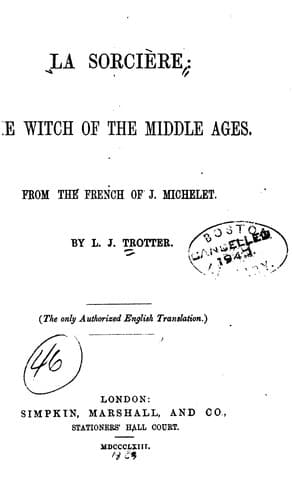
La Sorcière: The Witch of the Middle AgesMichelet, Jules
History
La Sorcière: The Witch of the Middle Ages
Michelet, Jules
Demonomania -- History -- To 1500; Satanism -- History -- To 1500; Superstition -- History -- To 1500; Witchcraft -- History -- To 1500
They withdraw respectfully, leaving these two alone. Behold him face
to face with his bleeding victim, so pale, so weak, but agitated all
the more! Anyone would have been greatly moved. The avowal expressed
by her blood, her wounds, rather than spoken words, was likely to
reach his heart. It was a humbling sight; but who would not have
pitied her? This innocent girl could for one moment yield to nature!
In her short unhappy life, a stranger as she was to the charms of
sense, the poor young saint could still show one hour of weakness! All
he had hitherto enjoyed of her without her knowledge, became mere
nought. With her soul, her will, he would now be master of everything.
In her deposition Cadière briefly and bashfully said that she lost all
knowledge of what happened next. In a confession made to one of her
friends she uttered no complaints, but let her understand the truth.
And what did Girard do in return for so charmingly bold a flight of
that impatient heart? He scolded her. He was only chilled by a warmth
which would have set any other heart on fire. His tyrannous soul
wanted nothing but the dead, the merest plaything of his will. And
this girl, by the boldness of her first move, had forced him to come.
The scholar had drawn the master along. The peevish pedant treated the
matter as he would have treated a rebellion at school. His lewd
severities, his coolly selfish pursuit of a cruel pleasure, blighted
the unhappy girl, who now had nothing left her but remorse.
It was no less shocking a fact, that the blood poured out for his sake
had no other effect than to tempt him to make the most of it for his
own purposes. In this, perhaps his last, interview he sought to make
so far sure of the poor thing’s discretion, that, however forsaken by
him, she herself might still believe in him. He asked if he was to be
less favoured than the nuns who had seen the miracle. She let herself
bleed before him. The water with which he washed away the blood he
drank himself,[113] and made her drink also, and by this hateful
communion, he thought to bind fast her soul.
[113] This communion of blood prevailed among the Northern
_Reiters_. See my _Origines_.
Public-domain text, read in full here on John Shaqi.
Reviews
Reviews
No reviews yet
Be the first to share your thoughts on this work.
Elsewhere in the archive
Join the Discussion
Join the discussion
Sign in to leave a comment or review.
Sign InorCreate an account