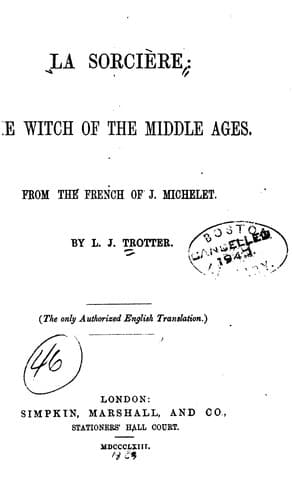
La Sorcière: The Witch of the Middle AgesMichelet, Jules
History
La Sorcière: The Witch of the Middle Ages
Michelet, Jules
Demonomania -- History -- To 1500; Satanism -- History -- To 1500; Superstition -- History -- To 1500; Witchcraft -- History -- To 1500
They durst not take this memoir to the bishop. But they got their
friend, little Camerle, his youthful chaplain, to steal it from them.
The bishop read it, and circulated some copies about the town. On the
21st August, Girard being at the palace, the bishop laughingly said to
him, “Well, father, so your name is in the Book of Life!”
He was overcome, fancied himself lost, wrote to Cadière in terms of
bitter reproach. Once more with tears he asked for his papers. Cadière
in great surprise vowed that her memoir had never gone out of her
brother’s hands. But when she found out her mistake, her despair was
unbounded. The sharpest pangs of body and soul beset her. Once she
thought herself on the point of death. She became like one mad. “I
long so much to suffer. Twice I caught up the rod of penance, and
wielded it so savagely as to draw a great deal of blood.” In the midst
of this dreadful outbreak, which proved at once the weakness of her
head and the boundless tenderness of her conscience, Guiol finished
her by describing Girard as nearly dead. This raised her compassion to
the highest pitch.
She was going to give up the papers. And yet it was but too clear
that these were her only safeguard and support, the only proofs of her
innocence, and the tricks of which she had been made the victim. To
give them up was to risk a change of characters, to risk the
imputation of having herself seduced a saint, the chance, in short, of
seeing all the blame transferred to her own side.
But, if she must either be ruined herself or else ruin Girard, she
would far sooner accept the former result. A demon, Guiol of course,
tempted her in this very way, with the wondrous sublimity of such a
sacrifice. God, she wrote, asked of her a bloody offering. She could
tell her of saints who, being accused, did not justify, but rather
accused themselves, and died like lambs. This example Cadière
followed. When Girard was accused before her, she defended him,
saying, “He is right, and I told a falsehood.”
She might have yielded up the letters of Girard only; but in so great
an outflowing of heart she would have no haggling, and so gave him
even copies of her own.
Thus at the same time he held these drafts written by the Jacobin, and
the copies made and sent him by the other brother. Thenceforth he had
nothing to fear: no further check could be given him. He might make
away with them or put them back again; might destroy, blot out, and
falsify at pleasure. He was perfectly free to carry on his forger’s
work, and he worked away to some purpose. Out of twenty-four letters,
sixteen remain; and these still read like elaborately forged
afterthoughts.
Public-domain text, read in full here on John Shaqi.
Reviews
Reviews
No reviews yet
Be the first to share your thoughts on this work.
Elsewhere in the archive
Join the Discussion
Join the discussion
Sign in to leave a comment or review.
Sign InorCreate an account