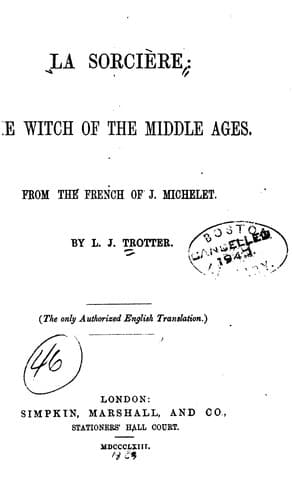
La Sorcière: The Witch of the Middle AgesMichelet, Jules
History
La Sorcière: The Witch of the Middle Ages
Michelet, Jules
Demonomania -- History -- To 1500; Satanism -- History -- To 1500; Superstition -- History -- To 1500; Witchcraft -- History -- To 1500
Larmedieu was a compliant judge, a friend of the clergy. He was not
one of your rude magistrates who go straight before them, like blind
boars, on the high-road of the law, without seeing or respecting
anyone. He had shown great regard for Aubany, the patron of Ollioules,
during his trial; helping him to escape by the slowness of his own
procedure. Afterwards, when he knew him to be at Marseilles, as if
that was far from France, in the _ultima thule_ or _terra incognita_
of ancient geographers, he would not budge any further. This, however,
was a very different case: the judge who was so paralytic against
Aubany, had wings, and wings of lightning, for Cadière. It was nine in
the morning when the dwellers in the lane saw with much curiosity a
grand procession arrive at the Cadières’ door, with Master Larmedieu
and the episcopal advocate at the head, honoured by an escort of two
clergymen, doctors of theology. The house was invaded: the sick girl
was summoned before them. They made her swear to tell the truth
against herself; swear to defame herself by speaking out in the ears
of justice matters that touched her conscience and the confessional
only.
She might have dispensed with an answer, for none of the usual forms
had been observed: but she would not raise the question. She took the
oath that was meant to disarm and betray her. For, being once bound
thereby, she told everything, even to those shameful and ridiculous
details which it must be very painful for any girl to acknowledge.
Larmedieu’s official statement and his first examination point to a
clearly settled agreement between him and the Jesuits. Girard was to
be brought forward as the dupe and prey of Cadière’s knavery. Fancy a
man of sixty, a doctor, professor, director of nuns, being therewithal
so innocent and credulous, that a young girl, a mere child, was enough
to draw him into the snare! The cunning, shameless wanton had beguiled
him with her visions, but failed to draw him into her own excesses.
Enraged thereat, she endowed him with every baseness that the fancy of
a Messalina could suggest to her!
So far from giving grounds for any such idea, the examination brings
out the victim’s gentleness in a very touching way. Evidently she
accuses others only through constraint, under the pressure of her oath
just taken. She is gentle towards her enemies, even to the faithless
Guiol who, in her brother’s words, had betrayed her; had done her
worst to corrupt her; had ruined her, last of all, by making her give
up the papers which would have insured her safety.
The Cadière brothers were frightened at their sister’s artlessness. In
her regard for her oath she gave herself up without reserve to be
vilified, alas! for ever; to have ballads sung about her; to be mocked
by the very foes of Jesuits and silly scoffing libertines.
Public-domain text, read in full here on John Shaqi.
Reviews
Reviews
No reviews yet
Be the first to share your thoughts on this work.
Elsewhere in the archive
Join the Discussion
Join the discussion
Sign in to leave a comment or review.
Sign InorCreate an account