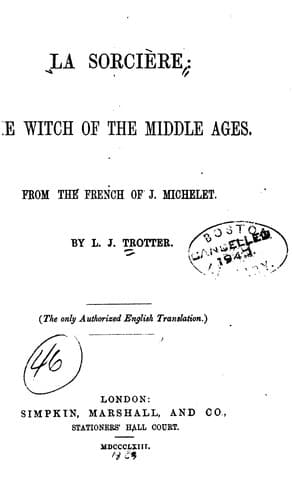
La Sorcière: The Witch of the Middle AgesMichelet, Jules
History
La Sorcière: The Witch of the Middle Ages
Michelet, Jules
Demonomania -- History -- To 1500; Satanism -- History -- To 1500; Superstition -- History -- To 1500; Witchcraft -- History -- To 1500
In sight of the popular feeling, no one dared to follow up the savage
sentence of the bench, by getting Cadière hanged. Twelve councillors
sacrificed their honour, by declaring Girard innocent. Of the twelve
others, some Jansenists condemned him to the flames as a wizard; and
three or four, with better reason, condemned him to death as a
scoundrel. Twelve being against twelve, the President Lebret had to
give the casting vote. He found for Girard. Acquitted of the capital
crime of witchcraft, the latter was then made over, as priest and
confessor, to the Toulon magistrate, his intimate friend Larmedieu,
for trial in the bishop’s court.
The great folk and the indifferent ones were satisfied. And so little
heed was given to this award, that even in these days it has been said
that “both were _acquitted_.” The statement is not correct. Cadière
was treated as a slanderer, was condemned to see her memorials and
other papers burnt by the hand of the executioner.
There was still a dreadful something in the background. Cadière being
so marked, so branded for the use of calumny, the Jesuits were sure to
keep pushing underhand their success with Cardinal Fleury, and to urge
her being punished in some secret, arbitrary way. Such was the notion
imbibed by the town of Aix. It felt that, instead of sending her home,
Parliament would rather _yield her up_. This caused so fearful a rage,
such angry menaces, against President Lebret, that he asked to have
the regiment of Flanders sent thither.
Girard was fleeing away in a close carriage, when they found him out
and would have killed him, had he not escaped into the Jesuits’
Church. There the rascal betook himself to saying mass. After his
escape thence he returned to Dôle, to reap honour and glory from the
Society. Here, in 1733, he died, _in the perfume of holiness_. The
courtier Lebret died in 1735.
Cardinal Fleury did whatever the Jesuits pleased. At Aix, Toulon,
Marseilles, many were banished, or cast into prison. Toulon was
specially guilty, as having borne Girard’s effigy to the doors of his
_Girardites_, and carried about the thrice holy standard of the
Jesuits.
According to the terms of the award, Cadière should have been free to
return home, to live again with her mother. But I venture to say that
she was never allowed to re-enter her native town, that flaming
theatre wherein so many voices had been raised in her behalf.
If only to feel an interest in her was a crime deserving imprisonment,
we cannot doubt but that she herself was presently thrown into prison;
that the Jesuits easily obtained a special warrant from Versailles to
lock up the poor girl, to hush up, to bury with her an affair so
dismal for themselves. They would wait, of course, until the public
attention was drawn off to something else. Thereon the fatal clutch
would have caught her anew; she would have been buried out of sight in
some unknown convent, snuffed out in some dark _In pace_.
Public-domain text, read in full here on John Shaqi.
Reviews
Reviews
No reviews yet
Be the first to share your thoughts on this work.
Elsewhere in the archive
Join the Discussion
Join the discussion
Sign in to leave a comment or review.
Sign InorCreate an account