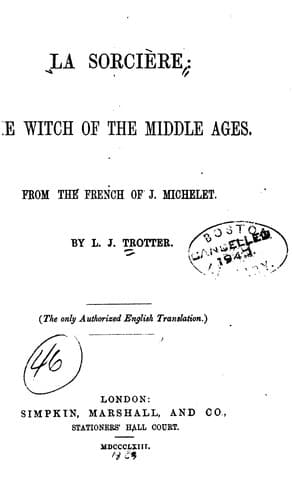
La Sorcière: The Witch of the Middle AgesMichelet, Jules
History
La Sorcière: The Witch of the Middle Ages
Michelet, Jules
Demonomania -- History -- To 1500; Satanism -- History -- To 1500; Superstition -- History -- To 1500; Witchcraft -- History -- To 1500
Know you, then, what it is that raises a protest, that keeps these two
spirits steadily apart, preventing them from coming nearer? It is a
huge reality, born five hundred years ago; a gigantic creation
accursed by the Church, even that mighty fabric of science and modern
institutions, which she excommunicated stone by stone, but which with
every anathema has grown a storey higher. You cannot name one science
which has not been itself a rebellion.
There is but one way of reconciling the two spirits, of joining into
one the two churches. Demolish the younger, that one which from its
first beginning was pronounced guilty and doomed as such. Let us, if
we can, destroy the natural sciences, the observatory, the museum, the
botanical garden, the schools of medicine, and all the modern
libraries. Let us burn our laws, our bodies of statutes, and return to
the Canon Law.
All these novelties came of Satan. Each step forward has been a crime
of his doing.
He was the wicked logician who, despising the clerical law, preserved
and renewed that of jurists and philosophers, grounded on an impious
faith, on the freedom of the will.
He was that dangerous magician who, while men were discussing the sex
of angels and other questions of like sublimity, threw himself
fiercely on realities, and created chemistry, physics, mathematics--ay,
even mathematics. He sought to revive them, and that was rebellion.
People were burnt for saying that three made three.
Medicine especially was a Satanic thing, a rebellion against disease,
the scourge so justly dealt by God. It was clearly sinful to check the
soul on its way towards heaven, to plunge it afresh into life!
What atonement shall we make for all this? How are we to put down, to
overthrow, this pile of insurrections, whereof at this moment all
modern life is made up? Will Satan destroy his work, that he may tread
once more the way of angels? That work rests on three everlasting
rocks, Reason, Right, and Nature.
* * * * *
So great is the triumph of the new spirit, that he forgets his
battles, hardly at this moment deigns to remember that he has won.
It were not amiss to remind him of his wretched beginnings, how
coarsely mean, how rude and painfully comic were the shapes he wore in
the season of persecution, when through a woman, even the unhappy
Witch, he made his first homely flights in science. Bolder than the
heretic, the half-Christian reasoner, the scholar who kept one foot
within the sacred circle, this woman eagerly escaped therefrom, and
under the open sunlight tried to make herself an altar of rough
moorland stones.
She has perished, as she was certain to perish. By what means? Chiefly
by the progress of those very sciences which began with her, through
the physician, the naturalist, for whom she had once toiled.
The Witch has perished for ever, but not the Fay. She will reappear in
the form that never dies.
Public-domain text, read in full here on John Shaqi.
Reviews
Reviews
No reviews yet
Be the first to share your thoughts on this work.
Elsewhere in the archive
Join the Discussion
Join the discussion
Sign in to leave a comment or review.
Sign InorCreate an account