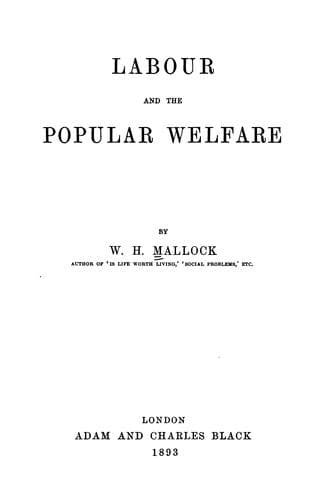
Labour and the Popular WelfareMallock, W. H. (William Hurrell)
General
Labour and the Popular Welfare
Mallock, W. H. (William Hurrell)
Labor; Labor movement; Socialism; Working class
◆¹ To this question it is altogether impossible to give any answer
based upon _à priori_ reasoning. The very idea of such a thing is
ridiculous; and to attempt it could, at the best, result in nothing
better than some piece of academic ingenuity, having no practical
meaning for man, woman, or child. But what reasoning will not do,
industrial history will. Industrial history will provide us with an
answer of the most striking kind—general, indeed, in its character;
but not, for that reason, any the less decided, or less full of
instruction. For industrial history, in a way which few people realise,
will show us how, during the past hundred years, Labour has actually
succeeded in accomplishing the feat we are considering; how, without
checking the development and the power of Ability, it has been able to
appropriate year by year a certain share of what Ability produces. When
the reader comes to consider this,—which is the great industrial object
lesson of modern times,—when he sees what the share is which Labour
has appropriated so triumphantly, he will see how the conclusions we
have here arrived at, with regard to the causes of production, afford
a foundation for the hopes and claims of Labour, as broad and solid as
that by which they support the rights of Ability.
Let us turn, then, once more to the fact which I have already so
often dwelt upon, that during the closing years of the last century
the population of Great Britain was about _ten millions_, and the
national income about a _hundred and forty million pounds_. It has been
shown that to reach and maintain that rate of production required the
exertion of an immense amount of Ability, and the use of an immense
Capital which Ability had recently created. But let me repeat what
I have said already: that we will, for the purpose of the present
argument, attribute the production of the whole to average human
Labour. It is obvious that Labour did not produce more, for no more
was produced; and it is also obvious that if, since that time, it
had never been assisted and never controlled by Ability, the same
amount of Labour would produce no more now. We are therefore, let me
repeat, plainly understating the case if we say that British Labour
by itself—in other words, Labour shut out from, and unassisted by the
industrial Ability of the past ninety years—can, at the utmost, produce
annually a _hundred and forty million pounds_ for every _ten millions_
of the population.
[Sidenote ◆1 In 1860 Labour took at least twenty-five per cent
more than it produced itself, out of the products of
Ability; and it now takes about forty-five per cent.]
Public-domain text, read in full here on John Shaqi.
Reviews
Reviews
No reviews yet
Be the first to share your thoughts on this work.
Elsewhere in the archive
Join the Discussion
Join the discussion
Sign in to leave a comment or review.
Sign InorCreate an account