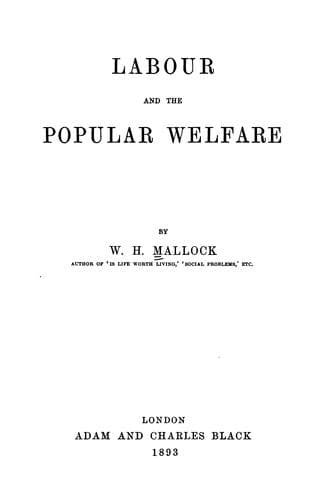
Labour and the Popular WelfareMallock, W. H. (William Hurrell)
General
Labour and the Popular Welfare
Mallock, W. H. (William Hurrell)
Labor; Labor movement; Socialism; Working class
◆¹ It is important to take notice of this truth; for a knowledge of
what is theoretically just, though it can never control classes so
far as to prevent their seizing on whatever they can obtain and keep,
exercises none the less a very strong influence on their views as to
how much of the wealth of other classes is obtainable, and also on
the temper in which, and the entire procedure by which, they will
endeavour to obtain it. ◆² For this reason it is impossible to insist
too strongly on the fact that, as a matter of theoretical justice,
Labour, as such, has no claim whatever on any of the interest paid
for the use of Capital; and that if it succeeds in obtaining any part
of this interest, it will be obtaining what has been made by others,
not what has been made by itself. It is not that such arguments as
these will extinguish the desire of Labour to increase its own wages
at the expense of interest, if possible; for might—the might that can
sustain itself, not the brute force of the moment—will always form in
the long run the practical rule of right; but they will disseminate a
dispassionate view of what the limits of possibility are, and on what
these limits depend.
[Sidenote ◆1 History shows us that they have been doing this
already,]
◆¹ And now let us turn to the facts of industrial history, and see
what light they throw on what has just been said. I have pointed out
that if Capital is to be made or used at all, it must necessarily,
for many reasons, be allowed to yield interest to its owners; but the
amount of interest it yields has varied at various times; and, although
to abolish it altogether would be impossible, or, if possible, fatal
to production, it is capable, under certain circumstances, of being
reduced to a minimum, without production being in any degree checked;
and every _pound_ which the man who employs Capital is thus relieved
from paying to the man who owns it constitutes, other things being
equal, a fund which may be appropriated by Labour. To say this is to
make no barren theoretical statement. The fund in question not only
may, under certain circumstances, be appropriated by Labour; but these
circumstances are the natural result of our existing industrial system;
and the fund, as I will now show, has been appropriated by Labour
already, and forms a considerable part of that additional income which
Labour, as we have seen, has secured from the income created by Ability.
[Sidenote ◆1 to an increasing extent.]
[Sidenote ◆2 Interest now forms but a small part of the income of
the nation,]
Public-domain text, read in full here on John Shaqi.
Reviews
Reviews
No reviews yet
Be the first to share your thoughts on this work.
Elsewhere in the archive
Join the Discussion
Join the discussion
Sign in to leave a comment or review.
Sign InorCreate an account