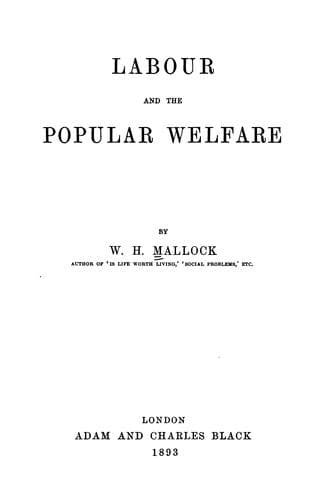
Labour and the Popular WelfareMallock, W. H. (William Hurrell)
General
Labour and the Popular Welfare
Mallock, W. H. (William Hurrell)
Labor; Labor movement; Socialism; Working class
Between the years 1862 and 1885 there were registered in the United
Kingdom about _twenty-five thousand_ joint stock companies, with an
aggregate Capital of about _two thousand nine hundred million pounds_.
Of these companies, by the year 1885, more than _fifteen thousand_
had failed, and less than _ten thousand_ were still existing. During
the following four years the proportion of failures was smaller; but
a return published in 1889 shows that of all the companies formed
during the past twenty-seven years, considerably more than half had
been wound up judicially. Therefore a man who secures a large return
on money invested in a business not under his own control, does so by
an exercise of sagacity not only beneficial to himself, but in a still
higher degree beneficial to the country generally; for he has helped
to direct human exertion into a profitable and useful channel, whereas
those who are less sagacious do but help it to waste itself.[49]
Of large returns on Capital, then, only a part is interest; the larger
part being merely another name for what we have shown to be the actual
creation of Ability—either the Ability with which the Capital has
been employed in directing Labour, or the Ability with which some new
method of directing Labour has been selected. There is accordingly no
contradiction in the two statements that Capital may often bring more
than fifteen per cent to the original investors; and yet that interest
on Capital in the present day is not more than three or three and a
half per cent. Here is the explanation of shares rising in value. A man
who at the starting of a business takes _a hundred one pound shares_
in it, and, when it is well established, gets _twenty pounds_ a year
as a dividend, will be able to sell his shares for something like _six
hundred pounds_; which means that little more than three per cent is
the interest which will be received by the purchaser.
[Sidenote ◆1 Interest, then, has decreased, and the whole sum thus
saved has gone to the labouring classes.]
Public-domain text, read in full here on John Shaqi.
Reviews
Reviews
No reviews yet
Be the first to share your thoughts on this work.
Elsewhere in the archive
Join the Discussion
Join the discussion
Sign in to leave a comment or review.
Sign InorCreate an account