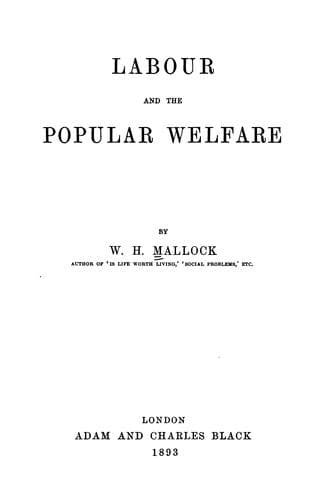
Labour and the Popular WelfareMallock, W. H. (William Hurrell)
General
Labour and the Popular Welfare
Mallock, W. H. (William Hurrell)
Labor; Labor movement; Socialism; Working class
Let me repeat in other words what I have just said. The labouring
classes, under the existing condition of things, have acquired more
wealth in a given time than the most sanguine Socialist of fifty
years ago could have promised them; and this increased wealth has
found its way into their pockets owing to causes that are in actual
operation round us. These causes, therefore, should be studied for two
reasons: firstly, in order that we may avoid hindering their operation;
secondly, in order that we may, if possible, accelerate it; and I shall
presently point out, as briefly, but as clearly as I can, what the
general character of these causes is.
[Sidenote ◆1 It is true that there are notorious facts that may
make the superficial or excitable observer doubt the
reality of this great progress of the labouring classes.]
◆¹ But before doing this,—before considering the cause of this
progress,—I must for a moment longer dwell and insist upon the reality
of it; because unhappily there are certain notorious facts which
constantly obtrude themselves on the observation of everybody, and
which tend to make many people deny, or at least doubt it. These facts
are as follows.
[Sidenote ◆1 But when these facts—viz. facts relating to the very
poor—are reduced to their true proportions,]
Speaking in round numbers, there exists in this country to-day a
population consisting of about _seven hundred thousand_ families,
or _three million_ persons, whose means of subsistence are either
insufficient, or barely sufficient, or precarious, and the conditions
of whose life generally are either hard or degrading, or both. A
considerable portion of them may, without any sentimental exaggeration,
be called miserable; and all of them may be called more or less
unfortunate. There is, further, this observation to be made. People who
are in want of the bare necessaries of life can hardly be worse off
absolutely at one period than another; but if, whilst their own poverty
remains the same, the riches of other classes increase, they do, in
a certain sense, become worse off relatively. The common statement,
therefore, that the poor are getting constantly poorer is, in this
relative sense, true of a certain part of the population; and that
part is now nearly equal in numbers to the entire population of the
country at the time of the Norman Conquest. Such being the case, it is
of course obvious that persons who, for purposes of either benevolence
or agitation, are concerned to discover want, misfortune, and misery,
find it easier to do so now than at any former period. London alone
possesses an unfortunate class which is probably as large as the whole
population of Glasgow; and an endless procession of rags and tatters
might be marched into Hyde Park to demonstrate every Sunday. But if
the unfortunate class in London is as large as the whole population of
Glasgow, we must not forget that the population of London is greater
Public-domain text, read in full here on John Shaqi.
Reviews
Reviews
No reviews yet
Be the first to share your thoughts on this work.
Elsewhere in the archive
Join the Discussion
Join the discussion
Sign in to leave a comment or review.
Sign InorCreate an account