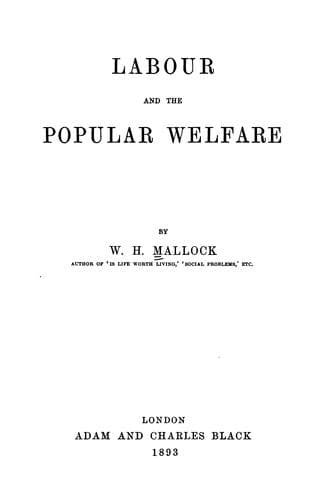
Labour and the Popular WelfareMallock, W. H. (William Hurrell)
General
Labour and the Popular Welfare
Mallock, W. H. (William Hurrell)
Labor; Labor movement; Socialism; Working class
Wages naturally decline then, owing to an increase of population, when
relatively to the population wealth declines also; but only then. ◆¹ On
the other hand,—and this is the important point to consider,—so long as
a country, under the existing system of production, continues, like our
own, to grow richer in proportion to the number of labourers, of every
fresh increase in riches the labourers will obtain a share, without any
political action or corporate struggle on their part, merely by means
of a natural and spontaneous process. And we have now seen in a broad
and general way what the character of this process is. It may seem,
however, to many people that a study of it and of its results can teach
no lesson but the lesson of _laisser faire_, which practically means
that the labourers have no interest in politics at all, and that all
social legislation and corporate action of their own is no better than
a waste of trouble, and is very possibly worse. But to think this is
to completely misconceive the matter. Even a study of this process of
natural distribution by itself would be fruitful of suggestions of a
highly practical kind; but if we would understand the actual forces
to which distribution is due, it must, as I have said already, not
be studied by itself, but taken in connection with others by which
its operation has been accelerated. I spoke of these as consisting of
deliberate and concerted actions in contradistinction to individual
and spontaneous actions; ◆² and these, speaking broadly, have been of
two kinds—the one represented by the organisation of Labour in Trade
Unions, the other by certain legislative measures, which, in a vague
and misleading way, are popularly described as “Socialistic.” Let us
proceed to consider these.
CHAPTER IV
_Of Socialism and Trade Unionism—the Extent and
Limitation of their Power in increasing the
Income of Labour._
[Sidenote ◆1 Legislation of the kind just alluded to is commonly
called Socialistic:]
[Sidenote ◆2 But this way of describing it is inaccurate;]
Public-domain text, read in full here on John Shaqi.
Reviews
Reviews
No reviews yet
Be the first to share your thoughts on this work.
Elsewhere in the archive
Join the Discussion
Join the discussion
Sign in to leave a comment or review.
Sign InorCreate an account