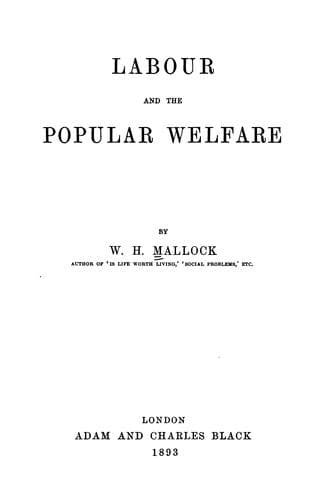
Labour and the Popular WelfareMallock, W. H. (William Hurrell)
General
Labour and the Popular Welfare
Mallock, W. H. (William Hurrell)
Labor; Labor movement; Socialism; Working class
able to save it, the motive of the producers was the desire to live on
the interest of it when it was saved; and that if it had not been for
the desire, the hope, the expectation of getting this interest, the
capital most certainly would never have been produced at all, or, at
all events, only a very minute fraction of it.
I asked in one of my articles in this Review whether Mr. Shaw thought
that a man who received ten thousand a year as the product of his
exceptional ability would value this sum as much if he were forbidden
by the State to invest a penny of it—if the State, in fact, were an
organised conspiracy to prevent his investing it so as to make an
independent provision for his family, or for himself at any moment
when he might wish to stop working—as he values it now when the State
is organised so as to make his investments secure? And the sole
indication in the whole of Mr. Shaw’s paper that he has ever realised
the existence of the question here indicated is to be found in a casual
sentence, in which he says that to think that the complete confiscation
of all the capital created by the two past generations, and the avowed
intention on the part of the State to confiscate all the capital that
is now being created by the present—to think, in other words, that the
annihilation of the strongest and fiercest hope that has ever nerved
exceptional men to make exceptional industrial exertion, would in the
smallest degree damp the energies of any able man—“is an extremely
unhistoric apprehension,” and one as to which he “doubts whether the
public will take the alarm.” And having said this, he endeavours to
justify himself by an appeal to history. He asks if the men who built
the Pyramids did not work just as hard “though they knew that Pharaoh
was at the head of an organised conspiracy to take away the Pyramids
from them as soon as they were made?”
Public-domain text, read in full here on John Shaqi.
Reviews
Reviews
No reviews yet
Be the first to share your thoughts on this work.
Elsewhere in the archive
Join the Discussion
Join the discussion
Sign in to leave a comment or review.
Sign InorCreate an account