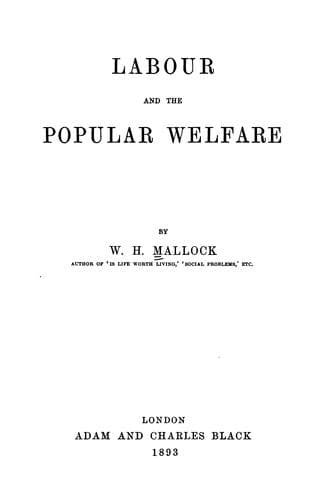
Labour and the Popular WelfareMallock, W. H. (William Hurrell)
General
Labour and the Popular Welfare
Mallock, W. H. (William Hurrell)
Labor; Labor movement; Socialism; Working class
Mr. Shaw, in order to prove how fully he understands the question of
Ability, quotes the case of a friend of his, who, by his Ability,
makes _four thousand pounds_ a year. This, says Mr. Shaw, is just as
it should be: but if a man, like his friend, should save _one hundred
thousand pounds_, and desire to leave this to his son, invested for
him at 3½ per cent, so that the son may receive an income whether he
has any of his father’s ability or no—this, says Mr. Shaw, is what
Socialism will not permit. The son must earn all he gets; and if he
happens to have no exceptional ability, which may probably be the case,
he will have to put up with the mere wages of manual labour. He will
have to live on some _eighty pounds_ a year instead of _four thousand
pounds_. And Mr. Shaw says, that to introduce this arrangement into
our social system will have no appreciable effect on the men who are
now making, by their ability, their _four thousand pounds_ a year. Let
us suggest to him the following reflections. What good, in that case,
would the _four thousand pounds_ a year be to the father, unless he
were to eat and drink nearly the whole of it himself? For it would
be absurd and cruel in him to bring up his children in luxury if the
moment he died they would have to become scavengers. Wealth is mainly
valuable, and sought for, not for the sake of the pleasures of sense
which it secures for a man’s individual nervous system, but for the
sake of the _entourage_—of the world—which it creates around him, which
it peoples with companions for him brought up and refined in a certain
way, and in which alone his mere personal pleasures can be fully
enjoyed. Capitalism, as Mr. Shaw truly observes, produces many personal
inequalities, which without it could not exist. He fails to understand
that it is precisely the prospect of producing such inequalities that
constitutes the main motive that urges able men to create Capital.
More than ten years ago I published a book called _Social Equality_,
devoted to the exposition of these truths. I cannot dwell upon them
now. In that book history is appealed to, and biography is appealed to;
and the special case of literary and artistic production, of which Mr.
Shaw makes so much, is considered in a chapter devoted to the subject,
and Mr. Shaw’s precise arguments are disposed of in anticipation. But
to a great extent the true doctrine of motive is one which cannot be
established by mere formal argument. It must to a great extent be left
to the verdict of the jury of general common sense, the judgment of men
of experience and knowledge of the world—that knowledge which, of all
others, Mr. Shaw and his friends appear to be most lacking in.
Public-domain text, read in full here on John Shaqi.
Reviews
Reviews
No reviews yet
Be the first to share your thoughts on this work.
Elsewhere in the archive
Join the Discussion
Join the discussion
Sign in to leave a comment or review.
Sign InorCreate an account