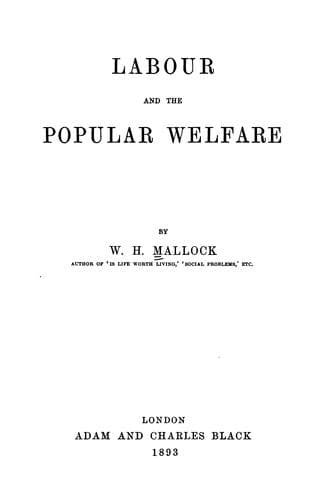
Labour and the Popular WelfareMallock, W. H. (William Hurrell)
General
Labour and the Popular Welfare
Mallock, W. H. (William Hurrell)
Labor; Labor movement; Socialism; Working class
[16] This classification of houses may perhaps be objected to; but
from the above point of view it is correct. Houses represent an annual
income of _one hundred and thirty-five million pounds_. Not more
than _thirty-five million pounds_ are spent annually in building new
houses; whilst the whole are counted as representing a new _one hundred
million pounds_ every year. It is plain, therefore, that if we estimate
the entire annual value as above, the sum in question stands not for
the houses, but for the use of them. Even more clearly does the same
reasoning apply to railways and shipping. Whether we send goods by
these or are conveyed by them ourselves, all that we get from them is
the mere service of transport. On transport and travelling by railway
about _seventy million pounds_ are spent annually: by ship about
_thirty million pounds_; by trams about _two million pounds_.
[17] The total annual imports are about _four hundred and twenty
million pounds_. The amount retained for home consumption is about
_three hundred and sixty-five million pounds_.
[18] The approximate value of the food consumed annually in the United
Kingdom (exclusive of alcoholic drinks) is _two hundred and ninety
million pounds_. The total value of food imported is over _one hundred
and fifty million pounds_.
[19] The number of persons fed on home-grown meat was _twenty-three
millions one hundred thousand_. The number fed on imported meat was
_fourteen millions seven hundred thousand_. In other words, the number
of persons who subsist on imported meat now is about equal to the
entire population of the United Kingdom in 1801.
[20] From the year 1843 to 1851, the annual income of the nation
averaged _five hundred and fifteen million pounds_, according to the
calculations of Messrs. Leone Levi, Dudley Baxter, Mulhall, and Giffen.
[21] The actual figures are as follows:—In 1887 the estimates of the
value of agricultural products per each individual actually engaged
in agriculture were: United Kingdom, _ninety-eight pounds_; France,
_seventy-one pounds_; Belgium, _fifty-six pounds_; Germany, _fifty-two
pounds_; Austria, _thirty-one pounds_; Italy, _thirty-seven pounds_.
[22] It is understating the case to say that the British operative
to-day works one hundred and eighty-nine hours less annually than
his predecessor of forty or fifty years ago, and one hundred and
eighty-nine hours = three weeks of nine hours a day. To this must be
added at least a week of additional holidays.
[23] The hours of labour in Switzerland are, on an average, sixty-six a
week.
[24] The agricultural population in France is about _eighteen
millions_; in this country, about _six millions_. The produce of France
is worth about _four hundred and fourteen million pounds_; of this
country, _two hundred and twenty-six million pounds_.
Public-domain text, read in full here on John Shaqi.
Reviews
Reviews
No reviews yet
Be the first to share your thoughts on this work.
Elsewhere in the archive
Join the Discussion
Join the discussion
Sign in to leave a comment or review.
Sign InorCreate an account