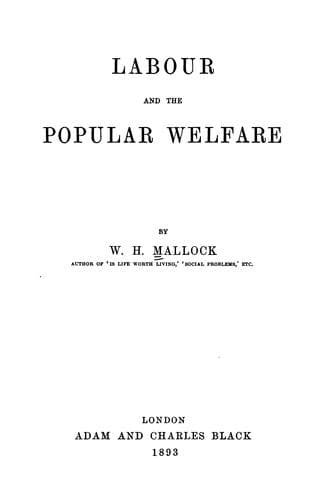
Labour and the Popular WelfareMallock, W. H. (William Hurrell)
General
Labour and the Popular Welfare
Mallock, W. H. (William Hurrell)
Labor; Labor movement; Socialism; Working class
[57] Though I have aimed at excluding from this volume all
controversial matter, I may here hazard the opinion that the
Socialistic principle is most properly applied to providing the
labourers, not with things that they would buy if they were able to do
so, but things that naturally they would not buy. Things procurable
by money may be divided into three classes—things that are necessary,
things that are superfluous, and things that are beneficial. Clothing
is an example of the first class, finery of the second, and education
of the third. If a man receives food from the State, otherwise than as
a reward for a given amount of labour, his motive to labour will be
lessened. If a factory girl, irrespective of her industry, was supplied
by the State with fashionable hats and jackets, her motive to labour
would be lessened also; for clothing and finery are amongst the special
objects to procure which labour is undertaken. But desire to be able to
pay for education does not constitute, for most men and women, a strong
motive to labour; and therefore education may be supplied by the State,
without the efficacy of their labour being interfered with.
[58] In our imaginary community we have at first eight labourers, who
produce _fifty pounds_ a year a-piece = _four hundred pounds_. Then
we have eight labourers + one able man, who produce _four hundred
pounds_ a year for each labourer = _three thousand two hundred pounds_.
Of this the able man takes _two thousand eight hundred pounds_. Now,
suppose the labourers strike for double wages, and succeed in getting
them, their total wages are _eight hundred pounds_ a year instead of
_four hundred pounds_; and the employer’s income is _two thousand four
hundred pounds_ instead of _two thousand eight hundred pounds_. The
labourers gain a hundred per cent; the employer loses little more than
fourteen per cent. The labourers therefore have a stronger motive in
demanding than the employer has in resisting. But let us suppose that,
the total income of the community remaining unchanged, the labourers
have succeeded in obtaining _one thousand eight hundred pounds_, thus
leaving the employer _one thousand four hundred pounds_. The situation
will now be changed. The labourers could not possibly now gain an
increase of a hundred per cent, for the entire income available would
not supply this; but let us suppose they strike for an increase of
_two hundred pounds_. If they gained that, their income would be _two
thousand pounds_, and that of the employer _one thousand two hundred
pounds_; but the former situation would be reversed. The employer now
would lose more than the labourer would gain. The labourers would gain,
in round numbers, only eleven per cent; and the employer would lose
fourteen per cent. Therefore the employer would have a stronger motive
in resisting than the labourers in demanding.
Public-domain text, read in full here on John Shaqi.
Reviews
Reviews
No reviews yet
Be the first to share your thoughts on this work.
Elsewhere in the archive
Join the Discussion
Join the discussion
Sign in to leave a comment or review.
Sign InorCreate an account