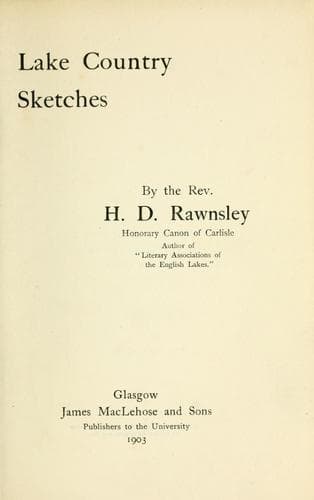
Lake country sketchesRawnsley, H. D. (Hardwicke Drummond)
General
Lake country sketches
Rawnsley, H. D. (Hardwicke Drummond)
Lake District (England); Wordsworth, William, 1770-1850 -- Homes and haunts -- England -- Lake District
But all the gifts of the angels of that April morning seemed as
nothing when compared with the joy of the sight of one single angel
of the spring--he a lustrous-backed swallow who flashed from
steel-purple into black and from black to steel-purple, and
disappeared from sight behind the larches. I had known of his
coming, for a swift-eyed shepherd had seen one of his kind in the
valley as early as April 1, but April 13 to the 15th was marked in my
calendar as swallowtide, and I had not expected sight of him till
this week. Here he was, glossy with African sun, and full of silent
message that summer was sure. The chiffchaff would be a-trill and
the cuckoo would be calling for a mate within the week. Ah, swallow!
swallow! flying north! How much of hope and happiness you bring.
Then as I moved through the larchen grove, I heard the titmice
whispering that they too were glad, they too felt reassured by sight
of the swallow, and one walked on in a kind of consciousness that man
and {230} swallow and budding larches were more akin than one had
believed, until the joyousness of spring found the selfsame echo in
such divers hearts, and that indeed the over-soul was one, the music
and the melody one voice. Yes, Wordsworth sang truly when he wrote:
One impulse from a vernal wood
May teach us more of man,
Of moral evil and of good,
Than all the sages can.
I met a child halfway up Latrigg braiding her hat with larch flower.
Truly no rubies ever seemed so rich and rare as these which the
simple village child had twisted in her hat; her sister had a handful
of primroses she was taking to her father in the neighbouring
cottage, for he was but slowly recovering from pneumonia, and the
child knew by instinct that a breath from a primrose posy would do
more for him than all the 'doctors' bottles' in the world.
'You have been up Skiddaw betimes,' I said.
'Ay, ay, sir; you see they've gone to "laate" Herdwicks to-day for
lambing-time, and I went up to the Gale with the dogs.'
Herdwicks! Lambing! What did it all {231} mean? Only that those
great brown slopes of Skiddaw which till this day have been vocal
with flocks and alive with sheep, will by this eventide be as silent
as the grave. For between April 10 and April 20 the shepherds know
that the Herdwicks will become mothers of their springtide young, and
so they will go forth to the fells and upland pastures, to bring
their woolly charges down from the mountain heights to the safety and
the food and care of the dale-farm enclosures. I overtook the
shepherds at the 'Gale,' and went with them. Soon the dogs were seen
scouring the fell-side, now disappearing from sight, now coming back
to get a signal from their master. A wave of the hand to left or
right was all that was needed, and away they went, and slowly and
surely they seemed to be able to search out and bring into a close
company the Herdwicks from all the heathery waste and grey-bleached
mountain hollows.
Public-domain text, read in full here on John Shaqi.
Reviews
Reviews
No reviews yet
Be the first to share your thoughts on this work.
Elsewhere in the archive
Join the Discussion
Join the discussion
Sign in to leave a comment or review.
Sign InorCreate an account