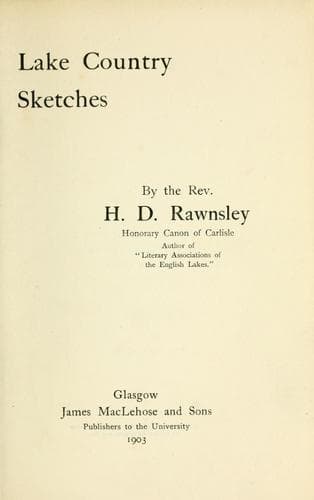
Lake country sketchesRawnsley, H. D. (Hardwicke Drummond)
General
Lake country sketches
Rawnsley, H. D. (Hardwicke Drummond)
Lake District (England); Wordsworth, William, 1770-1850 -- Homes and haunts -- England -- Lake District
This seems somewhat priggish, but it was the real and earnest William
Pearson who spoke. Sociable as he was, fond of seeing a good play,
his chief delight, if he was not out in the fields, was a book that
would set him thinking or a poem that would touch his imagination,
and Pearson was old beyond his years. He joined the Didactical
Society, the Mosley Street Library, subscribed to the News Room and
made one or two friends for life.
There in most uncongenial surroundings for seventeen years he stuck
to 'the drudgery at the desk's dead wood' with one thought, that a
time would arrive when he could come back to his native vale, and
live a student's and a naturalist's life in simple competence. As a
matter of fact his health broke down after five years of Manchester
smoke, and he had to come back in 1808 to the Yews in his native vale
for country air and restoration.
He was at this time nothing if not a keen sportsman, and he was, if
one may judge from a letter he sent at this time to a Kendal paper,
vexed at heart by the vigorous application of the game laws as
enforced by the worthies of the local bench. Three young men, who,
with nothing but a knob-stick, could run down {125} a hare, had been
caught hunting on Cartmel Fell. 'We must pity the Robinsons,' he
says, 'young men who can run down a hare, an animal that often
escapes the fleetest greyhound, who pursued their sport without fear
in the open day, and so generously, that they left a hare with the
farmer on whose ground they happened to take it. These fine young
men have been made to pay £3 13s. 6d. for their sport. The age of
chivalry is indeed gone. The ancient Greeks would have crowned them
with laurel, but this is the age of taxation and little men. We are
fallen on evil days; we only wish the surveyor and commissioner had
heard them at their joyous sport, and had heard their shouts, as we
did, which made the old mountains ring again even to Gummershow, to
be echoed back from the far-off Coniston Fells.'
It was during his Manchester residence that he became a student of
William Wordsworth. It was not fashionable then to care for
Wordsworth's poetry, but William Pearson was never without the
Lyrical Ballads of 1805, or his copy of _Poems by William
Wordsworth_, of 1807. The young bank clerk, who was often heard
muttering, 'I will lift mine eyes unto the hills, whence cometh aid,'
felt in these {126} poems 'all the beauty of a common dawn.' He knew
that Wordsworth walked on the shining uplands of a noble aspiration,
and was the apostle, in a time 'that touched monied worldlings with
dismay,' of the simpler life of honest poverty and high endeavour.
He felt that in Wordsworth he could find that sympathy with all
things, that
'Look to the Uncreated with a countenance
Of admiration and an eye of love.'
He knew that Wordsworth had realised the power of Nature to chasten
and subdue
Public-domain text, read in full here on John Shaqi.
Reviews
Reviews
No reviews yet
Be the first to share your thoughts on this work.
Join the Discussion
Join the discussion
Sign in to leave a comment or review.
Sign InorCreate an account