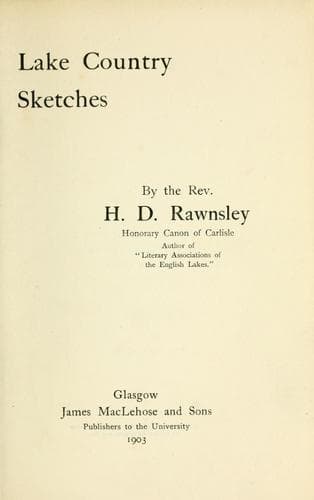
Lake country sketchesRawnsley, H. D. (Hardwicke Drummond)
General
Lake country sketches
Rawnsley, H. D. (Hardwicke Drummond)
Lake District (England); Wordsworth, William, 1770-1850 -- Homes and haunts -- England -- Lake District
'and intertwine
The passions that build up our human soul
Not with the mean and vulgar works of man
But with high objects and enduring things.'
He also knew how Wordsworth taught men the secret of the gentle heart,
'Never to blend its pleasure or its pride,
With sorrow of the meanest thing that feels.'
It was this knowledge that soon made him love rather to watch a wild
bird than shoot it. One is not surprised therefore to find him
constantly referring to Wordsworth's writings, and yet to feel him so
eminent as a man that years after, though communing in spirit with
{127} him day by day, he could not summon courage to go up the path
to Rydal Mount, and abashed at his own boldness for venturing to
call, came away from the door of the Rydal poet, without seeing his
hero, like a thing ashamed.
It was owing to mutual love and admiration for Wordsworth's poetry
that he found in a poor Gorton silk-weaver, Thomas Smith by name, so
congenial a companion. The last six years of Pearson's life at
Manchester can chiefly be known from the letters that passed between
these two friends, which towards the end seem almost to degenerate
into a series of begging letters from a poor weaver out of work and
'thrice dispirited.' But this at any rate is seen in their
correspondence, that even in abject poverty high thinking is
possible, and Wordsworth's poems seem to be medicine for the mind;
while on the other hand there is always the ready and generous
response of the yeoman of Winster Vale, and such delicacy in act of
gift as makes one feel how finely strung, how nobly sensitive was the
mind of the benefactor.
Pearson sends Thomas Smith a copy of _The Excursion_. 'Your tidings
about Wordsworth,' says the poor weaver, under date of April 15,
{128} 1821, 'I will not call him Mr., he is too great for that, were
good tidings indeed; his _Excursion_ I have been longing for ever
since it was first published, but the price has been an
unsurmountable obstacle to a weaver.'
The two friends unbosom their hearts to one another in these letters,
and there is seen something of the deep religious side of Pearson's
character in some of them. 'I cannot,' he writes to Smith in 1831,
'conclude without a word about what you write of your being unhappy.
Read your Bible. Trust in that Good Being who gave you your
existence. Consider the many in your situation who from ignorance
and want of education have not the arguments of hope that you have;
... only the wicked need be unhappy; at anyrate do not despair.' And
again in 1838, 'I wish I could console you under your troubles. Be
thankful you have not a guilty conscience--the greatest of evils.
Read your Bible, read Wordsworth, Shakespeare and Milton. Do you go
to worship, public, I mean? You have a chapel at the foot of your
hill, join yourself to them.'
Public-domain text, read in full here on John Shaqi.
Reviews
Reviews
No reviews yet
Be the first to share your thoughts on this work.
Join the Discussion
Join the discussion
Sign in to leave a comment or review.
Sign InorCreate an account