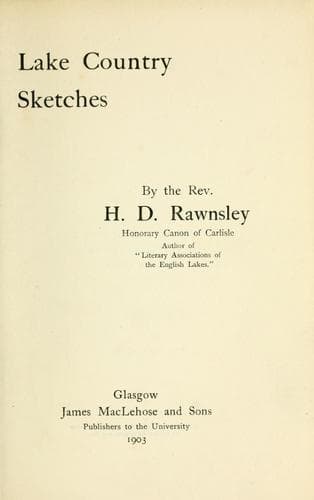
Lake country sketchesRawnsley, H. D. (Hardwicke Drummond)
General
Lake country sketches
Rawnsley, H. D. (Hardwicke Drummond)
Lake District (England); Wordsworth, William, 1770-1850 -- Homes and haunts -- England -- Lake District
It is no wonder that a yeoman farmer's son who could thus write,
should have felt irresistibly drawn from exile in Manchester to his
native vale, and we find him back at the Yews, in correspondence, now
with the editor of a county paper, now with Miss Wordsworth, now
writing a ballad or a poem, now a natural history note, now wandering
off down Duddon Vale, and through the Lake District, and now keenly
interested in a little dilapidated estate in the Crosthwaite township
called sometimes Borderside, sometimes Balderside, or perhaps more
accurately in Viking phrase, Bauta-side, and determining to go into
the farming line.
He became purchaser of the Borderside estate in 1822; at once he
determined to let it for five years, and gave his whole time and the
rent to boot, to the improvement of it.
In the summer of the same year that he became an estatesman, he
planned a tour into Scotland. Wordsworth wrote him a full and {132}
particular itinerary, and William Pearson followed the footsteps of
the bard, and really made the same journey as Wordsworth's first
excursion to Scotland.
There is an interesting note of the peasants recollection of Burns in
Ayrshire, and of the Sabbath manners of certain of the Auchterarder
folk, but the journal otherwise is a little tiresome.
The next ten years were spent in the not very profitable work of
mending the fences and outbuildings of Borderside, and then of
attempting to make its crops pay the rent and leave something over.
But in 1841 he 'declined' farming, not without the secret joy of
getting back to his mother's house at the Yews, where all his books
were stored, and where the _Encyclopædia_, just bound, was awaiting
him.
He had not been idle, he had made the Corn Laws a study, and had
concluded that they were unjust, cruel, and impolitic. He had done
what he could to get the Kendal folk to abolish the old system of
selling fruit by baskets, or paniers containing sixteen quarts, and
had introduced the better system of selling by weight.
In the spring of 1842 his mother died, and {133} now, at the age of
sixty-two, William Pearson felt free to marry. He married Ann
Greenhow of Heversham in May.
He was by instinct a tiller of the ground; he used to say that 'no
one felt more dependence upon God than the farmer in his fields.' He
turned his attention to fruit culture, planted a large orchard with
300 trees and two lesser ones, and felt that he had not lived in
vain. It was during this period that he began making notes of the
habits of the bird and beast life round about him. Some observations
on the habits of the hedgehog which he sent in 1836 to Mr. Wordsworth
were sent by the poet to the members of the Kendal Natural History
Society, of which Pearson had been a member almost from the first.
Public-domain text, read in full here on John Shaqi.
Reviews
Reviews
No reviews yet
Be the first to share your thoughts on this work.
Elsewhere in the archive
Join the Discussion
Join the discussion
Sign in to leave a comment or review.
Sign InorCreate an account